
⛩️ A Small Place for the Sacred Inside an Ordinary Japanese Home
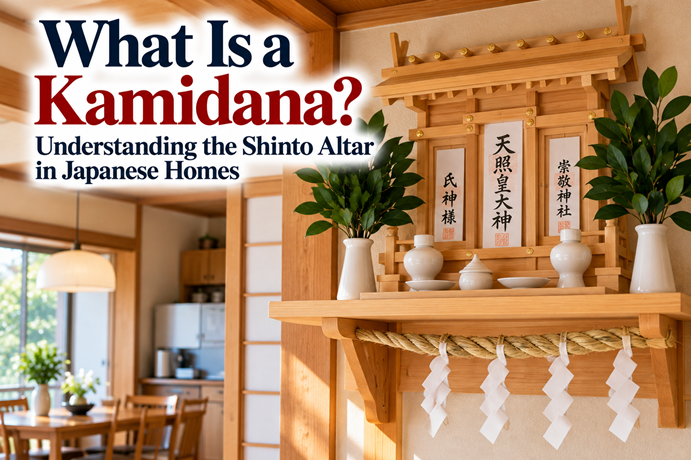
Imagine visiting a Japanese home and noticing a small wooden structure mounted high on a wall or placed on a dedicated shelf. It may resemble a miniature Shinto shrine, with a small architectural roof, wooden doors, and sacred talismans carefully placed inside. In front of it, you might see small white ceramic vessels containing rice, salt, or water, along with green branches arranged in narrow vases. The entire arrangement may be compact, yet its position and appearance make it clear that this is not an ordinary decorative object. You are looking at a kamidana, a traditional household space for enshrining Shinto deities through sacred talismans and related practices.
However, the most interesting part of this tradition is that a formal kamidana is not essential to every household that receives and keeps a sacred talisman. Some Japanese families have a traditional shrine-shaped structure, some use a simple shelf or a modern wall-mounted holder, and others display an ofuda—a sacred talisman received from a shrine—without having a full kamidana at all. The form can be very different from one home to another, depending on the family’s customs, religious relationship, available space, and the type of dwelling in which they live.
This distinction is important for understanding modern Japan. A kamidana is often presented as though it were a standard fixture in every traditional Japanese home, alongside tatami rooms, sliding doors, and other familiar features of Japanese interiors. Real homes are far more varied. Some families maintain a kamidana carefully, some receive an ofuda and display it in a modest place, some follow other household religious practices, and some have no kamidana or household Shinto display at all.
The deeper question is therefore not simply what a kamidana looks like. It is how a practice associated with Shinto shrines becomes part of everyday life inside a home, and how that practice adapts when the home itself changes.
That is what makes the kamidana such an interesting subject for understanding Japanese homes. It reveals a relationship between religious tradition, domestic space, seasonal routines, and the way people choose to remember and honor something that matters to them.
🏠 What Does Kamidana Actually Mean?
The word kamidana can be understood as a shelf for enshrining a kami, a deity or sacred presence in Shinto. In everyday English, it is usually translated as a “Shinto altar” or “household shrine,” although neither translation captures every aspect of the Japanese term. A traditional kamidana is generally arranged in a clean, elevated place inside the home, where sacred talismans can be enshrined and people may offer prayers or express gratitude as part of their daily lives.
There is also an important distinction between the shelf itself and the small shrine-shaped structure that may sit on it. The shelf is the kamidana in the more precise sense, while the architectural container used to house the sacred talismans is called a miyagata. In ordinary conversation, however, people may use kamidana to refer to the entire arrangement, including the shelf and the structure above it. Both uses are encountered, so understanding the difference helps when looking at traditional examples or shopping for one.
The miyagata is often modeled on the architecture of a Shinto shrine, with a roof, entrance, and a small interior space in which ofuda can be placed. The style and size vary considerably. Some are elaborate wooden structures, while others are simpler and designed to fit contemporary interiors. Traditional one-compartment and three-compartment designs are also available, with their arrangement affecting how multiple ofuda are placed.
Yet the most important point is that the wooden structure is not the deity itself. The ofuda is the sacred talisman received from a shrine and enshrined in the household arrangement. The miyagata provides a designated place for it, helping distinguish that sacred object from ordinary household possessions. This is why a full shrine-shaped structure can be meaningful, but it is not the only way to maintain the practice.
Understanding this distinction makes the rest of the tradition much easier to follow. A kamidana is not simply a miniature building placed on a shelf for decoration; it is part of a household practice centered on the respectful enshrinement of sacred talismans.
🎋 What Is an Ofuda, and Why Do People Bring One Home?
When people visit a Shinto shrine in Japan, they may receive an ofuda, often translated as a sacred talisman. An ofuda is different from a decorative souvenir, and its role is also different from that of the small protective charms commonly called omamori. While an omamori is generally carried on one’s person or kept in a bag, wallet, or other suitable place, an ofuda is typically enshrined at home or in another appropriate setting. The exact customs depend on the shrine and the type of talisman received.
There are several kinds of ofuda. One well-known example is the Jingū Taima, the sacred talisman associated with Ise Jingu and Amaterasu Ōmikami. Families may also receive an ofuda from the shrine associated with their residential area, often called the ujigami shrine, or from another shrine to which they feel a particular connection. These are not all interchangeable labels for the same object; they represent different relationships with particular shrines and traditions.
An ofuda may be kept to express reverence, gratitude, or a hope for protection and well-being in everyday life. Some households receive one during a New Year shrine visit, while others obtain one when they visit a particular shrine, move into a new home, or mark another occasion. Practices differ, and receiving an ofuda does not necessarily mean that a household follows an elaborate daily ritual. For some families, the display is a regular part of domestic life; for others, it is a quieter expression of faith or tradition.
This is an important detail for foreign readers because shrine visits in Japan are not limited to people who maintain a full household altar. A person may visit a shrine, pray for health or safety, receive an ofuda, and bring it home without purchasing a wooden miyagata or installing a dedicated shelf. The act of receiving the talisman and deciding how to enshrine it are related, but they are not the same thing.
The household arrangement can therefore be understood as one possible continuation of a shrine visit. Instead of leaving the experience entirely at the shrine, a person brings a sacred object into the home and gives it a place within everyday life.
🪵 A Traditional Kamidana: The Shrine-Shaped Structure
The most recognizable form of a kamidana consists of a shelf supporting a wooden miyagata, often designed to resemble a miniature Shinto shrine. Depending on the style, the structure may have a small roof, decorative architectural details, doors, and one or more compartments for ofuda. In front of it, there may be space for ritual vessels and offerings, with the entire arrangement placed high enough to distinguish it from ordinary furniture and everyday objects.
Traditional designs include ichisha-zukuri, commonly understood as a one-compartment form, and sansha-zukuri, a three-compartment form. These names describe different architectural arrangements rather than different levels of religious importance. The number of compartments affects how sacred talismans can be arranged, particularly in households that enshrine ofuda from several shrines.
The size of a traditional kamidana can vary dramatically. Some are modest structures intended for a small household space, while others are substantial enough to become a prominent feature of a traditional Japanese room. In a home with a dedicated Japanese-style interior, the kamidana may sit above furniture or occupy a specially prepared area. In other homes, it might be installed in a place that is visible when entering a room but does not interfere with the normal use of the space.
The visual resemblance to a miniature shrine is meaningful because it establishes a recognizable setting for the sacred talisman. The structure distinguishes the enshrined object from ordinary household belongings and gives it a dedicated location. In this sense, the miyagata helps transform an ordinary shelf or part of a room into a place set aside for household worship.
However, the form should not be treated as a rigid requirement for every Japanese household. Even within traditional practice, designs and arrangements vary by region and family. Some households have inherited an older kamidana, others buy a new one, and some prefer a much simpler arrangement. The key idea is not that every home needs the same wooden structure, but that the ofuda is treated respectfully and given an appropriate place.
📜 Not Every Home Has a Full Kamidana
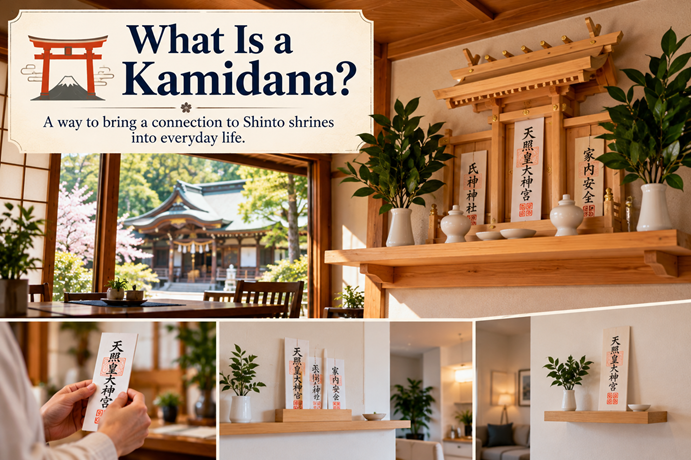
One of the most important things to understand about modern Japanese homes is that an ofuda can be enshrined without a traditional kamidana. A household may have no shrine-shaped miyagata, no dedicated shelf, and no collection of ceramic ritual vessels, yet still display a sacred talisman in a clean and respectful place. Some households use a simple stand, a small wall-mounted holder, or an existing shelf that has been prepared for the purpose.
This is not necessarily a modern departure from Japanese tradition. Historically, sacred talismans were not always housed in shrine-shaped structures; they could be displayed or placed in other ways. Over time, the use of a dedicated shelf and a shrine-shaped container became a widely recognized household arrangement, but different regions and families have retained different customs. The important principle is to provide the ofuda with a suitable place rather than assuming that a particular piece of furniture is mandatory.
This flexibility matters in contemporary life. Many people in Japan live in apartments, condominiums, or compact homes where there may be no traditional Japanese-style room and little spare wall space. A large wooden altar may be impractical, especially for someone who rents their home or does not want to make permanent changes to the interior. A small ofuda holder or a simple, carefully arranged display may be much more suitable.
Imagine two households. One has a spacious house with a traditional kamidana and several vessels for offerings. The other lives in a modern apartment and keeps a single ofuda on a small, elevated shelf. The physical arrangements are quite different, but both households may be expressing reverence through the way they treat the sacred talisman. It would be misleading to assume that the first household is necessarily more sincere simply because its arrangement is more elaborate.
This is a useful reminder that religious practice is not always measured by the size of the objects involved. The form of a household altar can reflect architecture, family history, available space, and individual preference as much as it reflects a person’s relationship with Shinto.
📍 Where Is a Kamidana Usually Placed?
A traditional kamidana is generally placed in a clean, orderly area of the home, often above normal eye level. An elevated position distinguishes the sacred arrangement from everyday objects and allows the ofuda to be enshrined in a place that is treated with respect. In many traditional recommendations, the front of the ofuda is oriented toward the south or east, although it is important not to treat direction as the only consideration.
The layout of a modern home can make the ideal arrangement difficult. A small apartment may not have a free wall in the preferred direction, while a rented home may not allow shelves to be installed. The more practical approach is to choose a location that is clean, reasonably quiet, and easy to maintain, where the sacred talisman can be treated respectfully without creating unnecessary inconvenience for the household.
Some people place a kamidana in a living room or another area where family members gather, while others choose a different suitable space. It is worth thinking about how the location works in everyday life. Can the space be kept clean? Is it possible to approach the arrangement comfortably? Will it be safe from accidental damage? Is the shelf likely to become crowded with unrelated objects? These questions are often more useful than trying to reproduce an idealized traditional interior in a home that was never designed for one.
In some Japanese households, the kamidana is positioned above a doorway or in a high area of a room. Where people need to pass underneath the arrangement, a sheet of paper marked 雲 (kumo, meaning “cloud”) may be placed on the ceiling above it. This is sometimes used to express the idea that there is sky or open space above the altar rather than another floor. However, practices vary, and this detail should not be treated as a universal requirement for every household.
The underlying principle is to create a respectful and maintainable place within the home that suits the dwelling, rather than allowing the search for a perfect location to prevent the household from enshrining the ofuda altogether.
🍚 The Offerings: Rice, Salt, and Water
A traditional kamidana may have several small vessels placed in front of the miyagata. These are part of the shingu, the ritual implements used for enshrining the kami and presenting offerings. One of the most familiar arrangements includes rice, salt, and water, while some households also offer sake and other items depending on their customs and the space available.
These offerings connect the household ritual to ordinary life in a simple but meaningful way. Rice is a staple food with a long history in Japanese agriculture and food culture. Water is essential to everyday life, while salt has historically been important in food preparation and preservation. Presenting these basic items at a kamidana gives them a place within a ritual of respect and gratitude.
In a traditional arrangement, rice may be placed centrally, with salt and water arranged nearby. Where sake is offered, it is commonly presented in small vessels designed for the purpose. The exact arrangement depends on the number of vessels and the household’s practice, so a small kamidana does not need to reproduce the layout of a large, formal shrine arrangement.
Some households also place branches of sakaki, an evergreen plant associated with Shinto ritual, in narrow vessels on either side of the altar. The green branches add a living element to the display and are commonly used in traditional arrangements. Depending on the setup, a small mirror, lamps, or other ritual objects may also be included, but not every kamidana contains all of these items.
The most important point is that the ritual objects support the practice; they are not a checklist that every household must complete. Someone who has a traditional kamidana may use several offerings and pieces of shingu, while a family with a simple ofuda holder may not have room for any of them. The presence or absence of particular objects should be understood in relation to the household’s circumstances and customs.
🌿 What Is Sakaki, and Why Is It Used?
If you look closely at a traditional kamidana, you may notice green branches placed in small vases on either side of the central structure. These are often branches of sakaki, an evergreen plant used in Shinto rituals. Its leaves remain green through much of the year, making it a familiar ritual plant associated with the enshrinement of kami.
The arrangement is usually simple, but it changes the visual character of the kamidana. Instead of being composed entirely of wood, ceramic, and paper, the display includes living greenery. In a home where the family replaces the branches regularly, the practice also introduces a small recurring task into household life, connecting care for the altar with the maintenance of the things placed before it.
As with the other components, however, sakaki should not be treated as mandatory in every domestic arrangement. Some households use traditional shingu and maintain the branches carefully, while others keep their setup much simpler. The choice may depend on family practice, available space, and how much time the household can devote to maintaining the display.
This is a recurring feature of the kamidana tradition: recognizable elements exist, but the way they are used can vary. A photograph of a fully equipped traditional altar shows one form of the practice, not necessarily the minimum arrangement for all homes.
🙏 What Do People Do in Front of a Kamidana?
Household worship in front of a kamidana can be very simple. Some people bow and clap their hands, then offer a silent prayer or express gratitude. Others may follow a daily routine in the morning, while some households only approach the kamidana on particular occasions. The actions and frequency differ, and it would be inaccurate to assume that all Japanese families perform a daily ritual.
The act of praying at home has a slightly different setting from visiting a public shrine. At a shrine, the visitor enters a shared sacred space, follows the customs of that shrine, and may be surrounded by other people. At home, the interaction takes place within an individual’s own living environment. The family decides how the space is maintained, when offerings are made, and how the practice fits into daily life.
For someone who observes the tradition without participating in it, the arrangement may look like a small shrine tucked into the corner of a room. For a family that uses it regularly, it may simply be part of the rhythm of getting up, beginning the day, or marking a significant event. The ritual does not have to be lengthy to be meaningful to the person performing it.
This difference between public and domestic religious practice is important. A person might visit a shrine only occasionally but maintain an ofuda at home. Someone else might visit shrines during New Year or other seasonal events but have no household altar. Another family may have a kamidana inherited from an earlier generation, even if only some members of the household actively use it.
In modern Japan, religious customs do not always follow one uniform pattern. The kamidana is one example of how a tradition can remain recognizable while the degree of participation differs between households.
🎍 The Kamidana and Japanese New Year
The end of the year is one of the most important times for many households that maintain a kamidana. As families prepare for the New Year, they may clean the altar, refresh the arrangement, and receive new ofuda from a shrine. The ritual can form part of the broader year-end preparation that includes cleaning the home, organizing belongings, and preparing to welcome the coming year.
For households that follow this practice, renewing the ofuda is not simply a matter of replacing an old piece of paper. It is a way to acknowledge the year that has passed and prepare for the next one. The old talisman has occupied a respected place in the household, and the family expresses gratitude before returning it to a shrine or an appropriate collection location.
The timing and details can vary, but many people renew their ofuda around the end of the year. Old ofuda are commonly returned to a shrine for otakiage, a ritual burning or ceremonial disposal of sacred items. When the original shrine is far away, the household can ask a nearby shrine whether it accepts the item. It is best not to assume that every shrine will accept every kind of old talisman, since local arrangements may differ.
This seasonal practice connects the kamidana with other New Year customs in Japan. Families may visit shrines, make wishes for the coming year, purchase new protective charms, or receive talismans associated with their home or family. Some of these activities take place outside the home, while the kamidana provides a way for the household’s relationship with the sacred to continue within its own space.
For some families, all of this forms a regular part of the year. For others, New Year is the main occasion when they think about ofuda or household shrine arrangements. Both patterns exist, and neither should be assumed to represent every Japanese home.
🏢 Kamidana in Japanese Offices and Shops
The kamidana is not limited to private homes. It can also be found in some offices, shops, restaurants, factories, and other workplaces. In these settings, a household-style altar may be used to enshrine an ofuda associated with the business or its local shrine. Some businesses maintain a kamidana as part of a long-standing company tradition, while others may have no such arrangement at all.
The reasons can differ from those of a private household. A business owner may pray for safety, the well-being of employees, the prosperity of the company, or continued success in its activities. A small shop might place its kamidana in an elevated position behind the counter, while a larger business may have a dedicated space for the arrangement. The form varies with the workplace and its customs.
This offers another way to understand the relationship between Shinto and daily life in Japan. A shrine visit is not always only a private event, and a household altar is not always confined to the family living room. In some contexts, the practice becomes part of the identity of a business or workplace, reflecting the hopes of the people who work there.
At the same time, it is important not to overgeneralize. Many Japanese businesses do not have a kamidana, and its presence should not be interpreted as a universal feature of Japanese corporate culture. Some workplaces may observe other customs, and some employees may not participate in religious practices at all. The kamidana is one tradition among a variety of ways that organizations can express their values and hopes for the future.
🏙️ How the Kamidana Fits Into Modern Apartments
The image of the kamidana is often associated with an older Japanese house, especially one with a traditional room, wooden fittings, and space for a dedicated altar. Modern housing, however, often looks very different. Many households live in apartments or condominiums with limited storage, contemporary furniture, and no obvious place to install a large wooden structure.
This has encouraged a range of smaller arrangements. Some people use compact wall-mounted kamidana designed to fit modern interiors, while others purchase simple ofuda holders that can sit on a shelf or desk. Some may use an existing high shelf, provided the location is appropriate and the sacred talisman can be displayed respectfully. The result can be minimal and understated, sometimes appearing almost like a piece of contemporary interior design.
The important thing to remember is that a modern form does not automatically mean that the tradition has been abandoned. A smaller arrangement can reflect the realities of the home rather than a lack of interest in the practice. It also means that an older custom can remain possible for people who do not have a traditional Japanese-style room or who live in rented accommodation where permanent installations are impractical.
This is particularly revealing when looking at how Japanese homes evolve. Some features of household life change along with architecture, furniture, family size, and work patterns. A tradition that once occupied a relatively large space may be adapted to a smaller one, while its central purpose remains recognizable.
In this sense, the modern kamidana is not simply an imitation of a historical object. It is one example of how a household tradition can adjust to contemporary living arrangements.
🪷 Kamidana and Butsudan: What Is the Difference?
Foreign visitors sometimes confuse a kamidana with a butsudan, another common type of religious furniture found in some Japanese homes. They can appear superficially similar because both may be placed in a dedicated part of the home and may contain objects treated with particular respect. However, their religious backgrounds and functions are different.
A kamidana is associated with Shinto and is used to enshrine ofuda and honor kami. A butsudan is associated with Buddhism and is generally used for the veneration of ancestors and Buddhist figures, often with family memorial tablets or other items connected to the household’s memorial practices. The precise arrangement varies with Buddhist tradition and family custom.
Some Japanese households have both a kamidana and a butsudan, reflecting the way Shinto and Buddhist practices can coexist in domestic life. Other households have one, the other, neither, or a much simpler arrangement. It is therefore not appropriate to assume that every home has both, or that the two structures have interchangeable purposes.
The distinction is useful because it shows why “Japanese household altar” is not a single category. Japan contains multiple religious traditions and forms of practice, and the objects used within the home often reflect different relationships with those traditions. Recognizing whether an arrangement is a kamidana or a butsudan helps explain what the household is doing and why the objects are placed as they are.
🧹 Maintaining a Kamidana: Care Rather Than Complexity
A kamidana requires some attention if the household intends to maintain it as a functioning place of worship. In traditional arrangements, people may keep the shelf and vessels clean, refresh the water and other offerings, and replace sakaki branches when necessary. Some households maintain a daily routine, while others do these things less frequently or follow their own family customs.
The practical requirements are not necessarily complicated, but consistency can matter to people who treat the kamidana as part of their daily lives. The shelf should remain clean, the sacred talismans should be handled respectfully, and the area should not become a place where unrelated objects accumulate. These are sensible principles for maintaining a dedicated sacred space, whether the arrangement is elaborate or very simple.
The task also illustrates something important about domestic traditions generally. A household practice survives not only because an object is present but because people continue to make space for it in their routines. A traditional kamidana may have been carefully built and passed down, but maintaining it still involves small actions carried out over time. A simple ofuda holder can express a similar intention through a much smaller arrangement.
There is no need to treat the most elaborate display as the only meaningful one. Someone living in a compact apartment may have neither the room nor the desire for a large altar, while a family in a traditional house may have maintained one for generations. The forms differ, and the care appropriate to each can differ too.
🌿 Why Does a Kamidana Matter in Everyday Japanese Life?
Perhaps the most interesting aspect of the kamidana is the way it makes a connection between the religious world of Shinto shrines and the ordinary domestic world of the household. The shrine is a public place that people visit, sometimes for special occasions and sometimes during everyday life. The kamidana, by contrast, creates a designated place within the home, where an ofuda can be enshrined and where a family may express gratitude or prayer without leaving the house.
That connection is not necessarily dramatic. It may be marked by a brief daily gesture, a seasonal renewal, or simply the presence of a sacred talisman in a particular place. For some households, the practice is central to family life; for others, it is more occasional or symbolic. The important point is that the tradition offers a way for a relationship with a shrine or kami to remain part of domestic space rather than being limited to the moment of a visit.
The kamidana also shows how the meaning of a home extends beyond its rooms and furniture. Homes are places to sleep, eat, work, relax, and store possessions, but they can also contain objects connected to family history, seasonal observances, personal memories, and spiritual beliefs. These objects do not have to be large or expensive to matter. Their significance comes from the place they occupy in the household’s life.
A kamidana is a particularly clear example because it is often deliberately set apart from ordinary belongings. Whether it takes the form of a traditional wooden structure or a simple ofuda holder, it creates a small location within the home that is treated differently from the surrounding space.
🇯🇵 What a Kamidana Reveals About Japanese Homes
A kamidana may look like a small architectural object, but it reveals several layers of Japanese domestic culture. It shows how a sacred talisman received at a shrine can be brought into the home, how a place can be set aside for religious practice, and how an older tradition can adapt to different kinds of housing. It also demonstrates that household customs are not always uniform: the same underlying practice can look very different depending on the family and the space available.
For some households, the image of a kamidana means a wooden miyagata, ceramic vessels, sakaki branches, and regular offerings of rice, salt, and water. For others, it may mean a small shelf with one ofuda, carefully displayed without a formal structure. Still others may not maintain a household Shinto display at all. These variations are part of the reality of modern Japan, where long-standing traditions coexist with different lifestyles and personal choices.
The most useful way to understand the kamidana is therefore not as a required feature of every Japanese home, nor as a decorative symbol of an unchanging past. It is a household practice that can take many forms, depending on how people choose to maintain their relationship with Shinto and how that practice fits into their everyday environment.
When you see a kamidana in a Japanese home or workplace, you are looking at more than a miniature shrine. You are seeing a way in which a sacred object is given a particular place within daily life, and a tradition is preserved through small acts of care, prayer, and renewal.
And when you see an ofuda displayed without an elaborate shrine-shaped structure, that too can be part of the same story.
The form may change with the home, but the central idea remains recognizable: a place is set aside to honor what the household considers sacred.
🔗 Explore More About Japanese Homes
The kamidana shows how Japanese homes can accommodate traditions alongside the practical realities of modern living. Continue exploring the Home Series to discover how the layout, objects, and everyday customs of Japanese houses reveal more about life in Japan.
👉 Japanese Kitchens vs. American Kitchens: Space, Storage, Appliances, and Daily Life
👉 Opening Windows in Japan: Fresh Air, Seasonal Breezes, and Everyday Home Life
👉 Why Are Washing Machines in Japan So Different? Top-Loaders, Drum Washers, and How Japanese Homes Dry Laundry (2026 Guide)
👉 Why Are Japanese Apartment Balconies So Useful? Laundry, Air Conditioners, and Emergency Escape Routes (2026 Guide)