
🌏 A Locker Can Tell You More About School Culture Than You Expect
When I was a child, I learned something about American schools long before I ever experienced one myself: the locker.
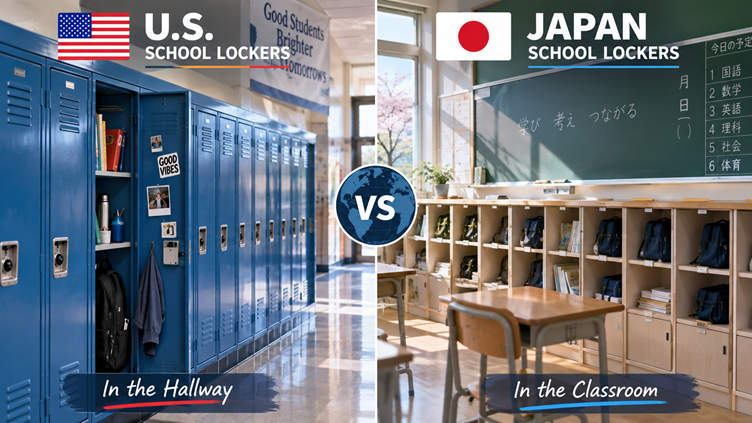
I saw them in movies and television series, filling long school hallways with rows of metal doors. Students would walk up to their lockers between classes, spin a combination lock, pull out a textbook, and talk with friends at the same time. Sometimes the scene was almost as important as the classroom itself. The hallway became a social space, and the locker seemed to belong to one particular student.
What fascinated me even more was what appeared inside.
Some lockers seemed to be covered with photographs of friends and family. There might be a picture of a favorite singer, a small mirror, stickers, notes, or other personal decorations. It looked almost like a tiny bedroom wall inside a school. The locker was not simply somewhere to keep books. It looked like a small piece of personal territory.
As a child growing up in Japan, that image felt surprisingly foreign to me.
Japanese schools have lockers too, but the experience is often very different. In many Japanese classrooms, lockers are placed toward the back or around the edge of the classroom, and students use them to organize school materials, bags, clothing, or other belongings. They are commonly open-front storage spaces rather than the individually locked metal compartments that appear so often in American movies. A Japanese classroom locker is generally understood as part of the classroom environment rather than a private little wall waiting to be decorated. Japan’s own Ministry of Education uses the locker as an ordinary classroom item in educational material introducing the Japanese classroom, alongside desks, chairs, shelves, bulletin boards, and cleaning equipment.
So why does this difference exist?
The interesting answer is not simply that Japanese students are less individualistic or that American students like decorating things more. The deeper difference is about what a school locker is understood to be in the first place. In one context, a locker can become an extension of the student. In another, it is primarily part of the system that keeps a classroom organized.
That small difference can reveal quite a lot about how students experience their school environment.
🎬 The American School Locker I Knew From Movies
For many people outside the United States, the American school locker is almost a cultural image in itself.
You can probably picture the scene: a student walks through a crowded hallway, stops at a particular locker, opens it, grabs a book, and continues a conversation with a friend without ever really leaving the social flow of the hallway. Maybe a student is rushing because the bell is about to ring. Maybe someone leaves a note inside another student’s locker. Maybe two friends stand in front of an open locker talking about what happened in class.
The locker is physically attached to the school building, but culturally it can feel like it belongs to the student.
That is what makes the decorations so interesting. A student may use photographs, magnets, mirrors, notes, or other objects to make the inside look more personal. Not every school permits this, and not every student decorates a locker. Rules vary considerably from school to school, and some modern American schools use lockers differently or have reduced their role as students rely more heavily on backpacks and digital materials. The movie image, therefore, should not be treated as a perfect picture of every American school in 2026.
But the cultural image still matters because it shows something important: in many American school settings, the locker can be imagined as a piece of personal space.
It is a place with your name attached to it. You may have a fixed locker number. You may have a combination or another form of access control. You may return to the same place every day. And, depending on school rules, you may have some opportunity to make that space look like yours.
That is a very different feeling from opening a shared-looking storage compartment at the back of a classroom and putting your textbooks inside.
🇯🇵 What Does a Japanese School Locker Actually Feel Like?
Walk into a typical Japanese classroom and you may notice something immediately: the locker does not necessarily announce itself.
Instead of a long hallway of individual metal doors, storage spaces may be incorporated into the classroom layout. Students can have designated spaces for textbooks, notebooks, bags, indoor shoes, or other belongings, depending on the school and age group. The exact design varies between schools, so there is no single Japanese locker system that applies everywhere.
What matters is the role.
The locker is generally there to help students manage their belongings and keep the classroom functional. Japanese school facility guidance has long emphasized providing storage furniture for students’ belongings and locating storage around the classroom in practical, visible places.
That sounds like a minor architectural choice, but it changes the feeling of the space.
When storage is designed primarily for organization, there is less reason to think of it as a personal display surface. A locker does not necessarily need a mirror. It does not need photographs of your friends. It does not need to announce your favorite musician or your personality to everyone walking past.
You put your things away.
Then you return to your desk.
The distinction is subtle, but it changes the relationship between the student and the object.
🔐 Why Are Japanese School Lockers Often Open and Unlocked?
One of the most surprising differences for someone familiar with the American movie image is the lack of a lock.
The first reaction might be, “Isn’t that insecure?”
But that question assumes that the locker has the same function in both systems.
A locker designed primarily as a personal container naturally creates a reason for personal security. A student has a designated compartment and expects that compartment to function as a private place for belongings.
A classroom storage locker can have a different purpose. It can be part of the general organization of the classroom rather than a miniature personal vault.
That does not mean Japanese schools have no secure storage or that students never use locked spaces. It simply means that individual locked lockers are not the only possible model for organizing student belongings.
The physical design follows the expected use.
This is one of the most interesting things about school architecture. Buildings quietly tell students what certain spaces are for without anyone needing to explain the philosophy behind them.
A closed metal locker with a lock says, at least partly, “this is your individual compartment.”
An open storage space says something closer to “this is where your belongings belong.”
Neither design is automatically better. They simply communicate different assumptions.
🪞 Why Don’t Japanese Students Usually Turn Lockers Into Personal Spaces?
This is where the question becomes more interesting than the simple answer of “because Japanese schools don’t allow it.”
Rules differ from school to school, and it would be misleading to claim that every Japanese school has an identical ban on locker decoration. The larger issue is that personal locker decoration is simply not as central to everyday Japanese school culture.
In the American imagination, decorating a locker can make sense because the locker itself already belongs to a student as a clearly defined personal space.
In a Japanese classroom, the storage area is much less likely to be treated that way.
The classroom is already a shared environment. The walls, blackboard, bulletin boards, desks, storage spaces, and other facilities are part of the collective classroom rather than a collection of individually claimed territories. Students certainly have personal possessions, but that does not automatically mean that every piece of the physical environment becomes a place for personal expression.
This is why it would be too simplistic to say that Japanese students are not interested in expressing themselves.
They are.
They simply have many other places to do it.
The design of a school locker does not have to carry the entire burden of personal identity.
🎒 Japan Doesn’t Lack Personal Expression
Look at the objects students actually carry.
A school bag can reveal preferences. A pencil case can be highly personal. Keychains and small accessories can become important expressions of taste. Students may choose particular stationery, character goods, sports-related items, or other accessories that have nothing to do with academic function.
In other words, personal expression does exist inside Japanese schools, but it does not necessarily happen by taking over a piece of permanent school architecture.
This distinction is important because comparisons between Japan and the United States often become too simple.
It is tempting to say, “American students express individuality, while Japanese students conform to the group.”
Real life is much messier.
Students in both countries have personalities, friendships, preferences, social groups, fashions, and ways of showing who they are. The difference is often where those expressions are permitted, expected, encouraged, or simply considered normal.
A photograph attached inside a locker may be perfectly natural in one school environment but feel strange in another, not because one group of students has more personality than the other, but because the object itself carries a different social meaning.
🏫 The Classroom Changes the Meaning of the Locker
There is another major difference that is easy to overlook: where the locker is located.
The classic American school locker is often associated with the hallway. That matters.
A hallway is a transition space. Students are moving from one class to another. They meet friends there. They stop briefly. They open lockers, exchange books, and continue moving.
The locker therefore becomes part of a social landscape.
In many Japanese schools, the locker is much more closely connected to the classroom. That changes everything.
The classroom is not simply a place where you spend forty or fifty minutes listening to a teacher before leaving. It is often the students’ regular base for much of the school day. Japanese schools also organize many everyday responsibilities around the class as a group, from classroom duties to cleaning and other shared routines.
That makes storage part of the functioning of the group.
The difference can be described in a single idea: the American-style locker can feel like a personal space within a public hallway, while the Japanese classroom locker often feels like shared classroom infrastructure used by individuals.
That is a much more interesting cultural difference than simply saying one has doors and the other does not.
🔑 A Locker Can Be a Small Territory
Think about what happens when a student is assigned a locker that has a lock and a fixed location.
The student knows, “This one is mine.”
That creates a tiny boundary.
It may not be private in the same way as a bedroom, of course, but it establishes a physical distinction between “my space” and “everyone else’s space.” Decorating the inside of that space then becomes completely understandable. You are making a territory feel more like yourself.
This is why the photographs in the movie scenes are so memorable.
A photograph of your family is not useful for storing books. A mirror does not help organize a textbook. A picture of your favorite musician has no practical relationship to mathematics class.
They are there because the locker has become something more than storage.
It has become identity attached to space.
Once you understand that, the difference with a Japanese classroom locker becomes much easier to see.
The Japanese locker does not necessarily need to become a student’s miniature bedroom because the culture surrounding the object has never required it to play that role.
🧑🤝🧑 The Difference Is Not Simply “Individual vs. Group”
This deserves special attention because it is one of the easiest places to write a bad article about Japanese school culture.
It would be very easy to conclude that American lockers represent individualism and Japanese lockers represent collectivism.
That explanation sounds neat.
It is also incomplete.
American schools contain shared rules, shared spaces, team activities, group expectations, and strong institutional structures. Japanese students have very personal interests, close friendships, hobbies, fashion preferences, and ways of distinguishing themselves from others.
The difference is not that one society has individuality and the other does not.
A more useful question is:
Where does individuality meet the physical environment?
In some American school environments, a personal locker provides an obvious place where the student can claim a small area within a much larger institution.
In many Japanese schools, the physical classroom is more strongly treated as a shared environment, while individual expression may appear through portable possessions and social relationships rather than permanent decoration.
That distinction avoids turning a physical object into a stereotype about an entire country.
🎥 What Movies Get Right—and What They Leave Out
For people outside the United States, movies have played an enormous role in creating an image of American schools.
And the locker is one of the strongest examples.
The rows of lockers, the combination locks, the hallway conversations, the student rushing to class, the opening and closing of doors: these images have become part of the international idea of what an American school looks like.
But movies naturally focus on visually interesting details.
A decorated locker is much more memorable on screen than a student quietly putting a textbook into an ordinary storage space.
That creates an interesting problem for anyone trying to understand school culture from movies. The image may be based on something real, but it can become more universal in our imagination than it actually is.
American schools vary enormously. Some schools have extensive locker systems. Some have restrictions on decoration. Some allow limited personalization. Some students decorate their lockers enthusiastically, while others barely use them. Some schools have changed their approach as backpacks, laptops, tablets, and different classroom designs have become more common.
So the right question in 2026 is not, “Do American students decorate their lockers?”
The better question is, “Why did the decorated personal locker become such a powerful image of American school life in the first place?”
The answer brings us back to the idea of personal territory.
💻 The Locker Culture Is Changing Too
There is an even more interesting twist.
The locker culture that many people outside America recognize from movies is itself changing.
Students no longer necessarily need to carry large stacks of textbooks from one class to another. Digital learning has changed what students physically carry. School architecture changes. Some schools use lockers differently or make less use of them. And when students want to show personality, the objects they carry can sometimes matter more than a permanent metal compartment.
A backpack can become a statement.
A water bottle can become a statement.
A laptop case, shoes, keychains, or other everyday objects can do the same thing.
In other words, personal expression does not disappear when the locker becomes less important. It can simply move somewhere else.
That makes the comparison with Japan especially interesting.
The question is not really whether Japanese students decorate lockers while American students do not.
The more interesting question is why different school environments have historically given students different places to express ownership and identity.
🧠 What Japanese School Lockers Reveal About Japanese School Culture
A Japanese school locker looks like a very ordinary object.
That may be exactly why it is worth studying.
Japanese school facility guidance treats storage as part of the practical organization of the learning environment, including the placement of storage furniture for students’ belongings within classroom spaces. The locker therefore fits naturally into a broader classroom structure in which students share a physical environment while keeping their individual belongings organized within it.
The important point is not that Japanese schools designed lockers specifically to teach collectivism. That would be far too strong a claim.
Rather, the locker reflects a wider pattern in which physical school spaces are expected to support everyday routines efficiently without necessarily becoming individual display spaces.
Put your things away.
Keep the classroom usable.
Move to the next activity.
The object does its job quietly.
And perhaps that is precisely why a child who grew up watching American movies might find the difference so striking. The two objects may both be called lockers in English, but the cultural meaning attached to them can be surprisingly different.
🌏 So, Why Don’t Japanese Students Decorate Their School Lockers?
The simplest answer is that Japanese school lockers are generally understood more as storage and classroom organization than as personal territory.
The longer answer is much more interesting.
In many American school settings, the traditional locker has been associated with an individual student, privacy, access control, hallway life, and personal identity. That makes decoration a natural possibility where school rules permit it.
In many Japanese schools, lockers are integrated into the classroom environment and are primarily used to keep students’ belongings organized. They are less likely to function as a student’s permanent personal display space, so decorating them is not normally an important part of school life.
Neither approach tells us which country values individuality more.
Instead, the locker shows us that individuality does not always need the same physical space.
The American locker can say, “This little area is mine.”
The Japanese classroom locker can say, “This is where I keep my things.”
Those sound like almost identical ideas until you imagine yourself standing in front of each one.
Then the difference becomes surprisingly large.
🇯🇵 The Smallest School Objects Can Reveal the Biggest Cultural Differences
This is one reason everyday school life is so interesting to explore.
You do not always need to look at famous traditions, temples, festivals, or ceremonies to understand a country. Sometimes a culture appears in something as ordinary as where students put their books.
A child watching an American movie may see a decorated locker and think, “That is your own little space.”
A Japanese student may see a classroom locker and think, “That is where I put my school things.”
Neither reaction is strange.
Each makes sense within the environment that produced it.
And that may be the most interesting lesson of all. Cultural differences are often not hidden in dramatic traditions. They can be embedded in tiny assumptions about ordinary objects: who owns them, who uses them, whether they are private or shared, whether they should be personalized, and what they are supposed to help people do.
A school locker is just a locker.
Until you ask what it means.
🌏 Continue Exploring the School Series
Japanese school life becomes much easier to understand when you look at the everyday routines behind it, rather than only the things visitors notice from the outside.
👉 Why Do Japanese Students Serve Their Own School Lunch? The Story Behind Kyūshoku Tōban (2026 Guide)
👉 Japanese Class Leaders: Why a Gakkyu Iin Is More Than a Student Representative (2026 Guide)
👉 The First Day Back: Why Japanese Schools Begin the New Term With an Opening Ceremony (2026 Guide)
👉 Stand, Bow, Sit: Why Japanese Students Bow to Teachers at the Start of Class? (2026 Guide)
👉 Why Do Japanese Schools Display Students’ Work on the Walls? (2026 Guide)
👉 Why Do Japanese Students Eat Lunch in Their Classrooms? (2026 Guide)