
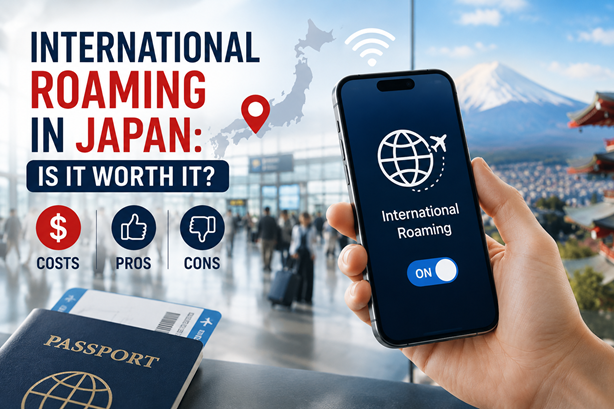
📱 Is International Roaming the Easiest Way to Use Your Phone in Japan?
For many travelers, the easiest way to stay connected in Japan may be the option they already have in their pocket.
If your mobile carrier supports international roaming in Japan, you may be able to land at Haneda or Narita, turn off airplane mode, and continue using your phone without buying a Japanese SIM card, installing an eSIM, or collecting a Pocket WiFi device.
That simplicity can be extremely valuable. After a long international flight, the last thing many travelers want to do is search for a rental counter, connect a new device, or troubleshoot a new SIM before they can even find their hotel.
However, international roaming is not automatically the best choice.
The price, amount of data, connection speed, calling charges, tethering rules, and activation process all depend on your mobile carrier and the plan you have at home. A roaming plan that is excellent for one traveler could be unnecessarily expensive for another.
So the important question is not simply, “Does international roaming work in Japan?”
The better question is:
“Is my carrier’s roaming plan good enough to make it worthwhile for my trip?”
Before looking specifically at international roaming, it helps to see where it fits among the four main ways international visitors can connect to mobile internet in Japan.
| eSIM | Physical SIM | Pocket Wi-Fi | International Roaming | |
|---|---|---|---|---|
| Best for | Most modern solo travelers | Phones without eSIM | Families and groups | Maximum convenience |
| Setup | Digital installation | Replace SIM card | Pick up or receive device | Usually activate with carrier |
| Phone compatibility | eSIM-compatible phone | Unlocked phone | Almost any Wi-Fi device | Carrier dependent |
| Multiple users | Usually one phone | Usually one phone | Several devices | Usually one phone |
| Japanese phone number | Usually no | Plan dependent | Usually no | Your existing number |
| Main advantage | Convenient and no physical SIM | Simple physical alternative | Share one connection | No new SIM needed |
| Main disadvantage | Requires compatible device | Requires SIM replacement | Device to carry and charge | Can be expensive |
| Best for Japan travel | ⭐⭐⭐⭐⭐ | ⭐⭐⭐ | ⭐⭐⭐⭐ | Depends on carrier |
This comparison is only a starting point. There is no universal winner because these options solve different problems.
The purpose of this guide is to look more closely at the fourth option: international roaming. If you already have a good roaming plan, it may be the most convenient solution available. If your carrier charges high roaming fees or gives you very little high-speed data, an eSIM may give you much more control. If you need to connect several devices, Pocket WiFi may still make more sense.
In other words, the best choice depends less on the technology itself and more on what you actually need during your trip.
🌏 What Is International Roaming?

International roaming allows your phone to connect to a mobile network outside your home country while continuing to use your existing mobile service.
You do not need to become a customer of a Japanese carrier. Instead, your home carrier has arrangements that allow your phone to use compatible networks while you are abroad.
From your perspective, the experience can be remarkably similar to using your phone at home. Your existing SIM or eSIM remains in your phone, your usual phone number generally stays with you, and your familiar apps and settings continue to work.
That is the fundamental difference between international roaming and buying a separate Japan travel SIM or eSIM.
With an eSIM, for example, you are adding a travel data plan specifically for Japan. With Pocket WiFi, you are using a separate Wi-Fi device. With international roaming, you are essentially extending your existing mobile service beyond your home country.
The exact experience depends on your carrier, plan, phone, and destination. Some plans include international roaming as part of the monthly service, while others require a separate travel package or charge for overseas use.
This is why the words “international roaming” alone do not tell you what the service will cost.
Your specific mobile plan is what matters.
✈️ How Does International Roaming Work in Japan?
For the traveler, international roaming can be remarkably simple.
Before leaving home, you check whether your carrier supports roaming in Japan and whether your current plan includes it. Depending on your carrier, you may need to activate an international roaming service, purchase a travel pass, or simply make sure the feature is enabled.
After arriving in Japan, your phone connects to an available partner network. Depending on your phone and carrier, you may need to turn on data roaming in your phone’s settings.
Once the connection is established, you can use mobile data for the things you normally use your phone for while traveling: Google Maps, translation, messaging, train information, restaurant searches, hotel reservations, and other everyday travel tasks.
This is where roaming has a major advantage.
There is no physical SIM to remove. There is no eSIM QR code to scan. There is no Pocket WiFi device to collect. You do not need to remember to return anything before leaving Japan.
Your phone simply continues to be your phone.
That does not mean you should activate roaming without checking the details first. The exact setup and pricing vary between carriers, and some plans require specific activation steps.
The simplest option is still worth checking before your flight.
⭐ Why Is International Roaming So Convenient?
The biggest advantage of international roaming is not necessarily the price.
It is continuity.
Your phone is already configured. Your apps are already installed. Your contacts are already there. Your authentication messages can continue arriving at your usual number, subject to your carrier’s roaming rules. You do not have to change the way you use your phone simply because you crossed an international border.
Imagine arriving at Haneda after a long flight. You collect your luggage, turn off airplane mode, and immediately use your phone to check your hotel reservation and navigate to the train station.
That is the appeal of roaming.
There is no need to find a rental counter before you can use the internet. There is no need to install a new data plan while sitting in the airport. There is no additional device in your luggage.
For some travelers, that convenience is worth paying for.
This is particularly true for short trips. If you are visiting Japan for only a few days and your carrier already offers an inexpensive or included Japan roaming option, buying another connectivity product may provide very little additional benefit.
The same can be true for business travelers and people who need to remain reachable through their existing phone number.
💰 How Much Does International Roaming Cost in Japan?
There is no standard international roaming price for Japan.
This is one of the most important things to understand before using it.
Your cost depends on your home carrier and the exact mobile plan you have. Some plans include overseas data within the normal monthly fee. Others offer a daily roaming package. Some use fixed-duration passes, while others may charge based on usage.
The amount of high-speed data can also vary considerably.
A plan described as offering unlimited data may still have a high-speed allowance, after which the connection becomes slower. Another plan might provide a fixed amount of high-speed data for a certain number of days.
Calls and SMS can also be treated differently from mobile data.
Therefore, looking only at the headline price can be misleading.
What matters is what you actually receive for that price.
A traveler who has a generous Japan roaming allowance included with their existing plan may have an excellent deal. Another traveler with a carrier that charges a substantial daily fee could potentially save money with an eSIM.
Neither traveler is making the wrong decision.
They simply have different mobile plans.
📊 International Roaming: What Are You Really Paying For?
International roaming is often described as expensive compared with travel eSIMs, but that comparison does not tell the whole story.
When you pay for roaming, you are also paying for simplicity. You are keeping your existing number, your existing mobile service, and your existing phone setup. You are avoiding the process of buying, installing, collecting, or returning another connectivity product.
The real value therefore depends on how much you value convenience.
| Factor | International Roaming |
|---|---|
| New SIM needed | No |
| New phone number | Usually no |
| Setup before travel | Usually minimal |
| Arrival convenience | Excellent |
| Data control | Depends on carrier |
| Cost predictability | Depends on plan |
| Multiple devices | Limited |
| Tethering | Plan dependent |
| Calls & SMS | Usually easiest |
| Main advantage | Maximum convenience |
| Main concern | Potentially high or unclear cost |
This is why international roaming can be either an excellent choice or a poor one.
If your carrier gives you a generous amount of Japan data for a reasonable price, roaming may be difficult to beat for convenience.
If your carrier’s Japan roaming package is expensive, an eSIM may be more attractive because you can choose a Japan-specific data plan separately.
📞 What About Your Existing Phone Number?
This is one of the strongest reasons some travelers prefer international roaming.
Because you are continuing to use your existing mobile service, your normal phone number generally remains associated with your phone.
That can be useful if you need to receive SMS messages, use services that rely on your existing number, or remain reachable while traveling.
For some travelers, this is more important than saving a few dollars on mobile data.
An eSIM can also be used alongside a primary SIM on compatible phones, but the exact configuration depends on the device and carriers involved. Pocket WiFi works differently because your phone connects to the internet through Wi-Fi rather than through your mobile carrier’s cellular connection.
International roaming therefore provides a particularly simple way to maintain continuity with your existing mobile service.
However, do not assume that calls, SMS, and data are all included under the same conditions.
Your carrier may treat each service differently, so check the details of your plan before traveling.
💻 Can You Use International Roaming With a Laptop?
Sometimes, but this is an area where you need to check your plan carefully.
A smartphone can use roaming directly through the mobile network, but connecting a laptop or tablet may require tethering or hotspot functionality.
Some carriers allow tethering while roaming, while others may impose restrictions.
This is one of the areas where Pocket WiFi can have a practical advantage. A Pocket WiFi is designed to provide one shared connection for several Wi-Fi-enabled devices, whereas international roaming normally begins with one smartphone.
For someone who only needs Google Maps, translation, messaging, and browsing on a phone, this may not matter at all.
For someone working remotely in Japan with a laptop, tablet, and smartphone, it becomes much more important.
Before relying on roaming for work, check specifically whether hotspot use is supported and whether hotspot data is subject to different limits.
👤 Who Is International Roaming Best For?
International roaming is particularly attractive to travelers who value maximum convenience.
A short-term visitor with an affordable Japan roaming plan may have little reason to purchase another connectivity option. If the plan provides enough data for the trip and the traveler is comfortable with the cost, roaming can eliminate several steps from the travel process.
It can also be a strong choice for travelers who need their existing phone number, receive important messages from home, or simply do not want to change their phone setup.
Business travelers may appreciate this continuity even more.
There is also a less obvious group that may benefit from roaming: people who do not want to think about connectivity at all.
Travel already involves enough decisions. If your current phone plan lets you arrive in Japan and simply use your phone, the simplicity itself can be valuable.
You may be able to spend slightly more on connectivity while saving yourself the time and effort of setting up something new.
⚖️ When Is an eSIM a Better Choice?
An eSIM becomes more attractive when you want more control over your data and connectivity costs.
Instead of relying on the international roaming conditions of your home carrier, you purchase a Japan-specific data plan from an eSIM provider.
This can make it easier to choose a plan according to the length of your trip and how much data you expect to use. You can also compare different providers rather than accepting whatever roaming option your home carrier provides.
An eSIM is particularly convenient because there is no physical device to carry.
The main requirement is that your smartphone supports eSIM and is compatible with the travel plan.
We cover this in much greater detail in our main Japan eSIM guide, including major providers, data plans, prices, Japanese networks, hotspot support, and the amount of data different travelers may need.
👉 Best eSIM for Japan Travel: Compare Plans, Data & Providers (2026 Guide)
📡 When Is Pocket WiFi a Better Choice?
Pocket WiFi becomes more attractive when your connectivity needs are shared across several devices or people.
A family might connect several smartphones to one Pocket WiFi. A traveler carrying a laptop and tablet might also prefer one dedicated internet connection rather than managing mobile data separately on each device.
But this does not mean that Pocket WiFi is automatically better for groups or that eSIM is automatically better for solo travelers.
As we discussed in our eSIM vs Pocket WiFi guide, the number of travelers is only one factor.
Data usage, the number of devices, whether people separate during the day, battery requirements, how much equipment you want to carry, and how much freedom you want all affect the decision.
Pocket WiFi also involves some logistics. You normally reserve the device, arrange pickup or delivery, use it during the trip, and return it afterward.
That may be very convenient for some travelers and unnecessary for others.
👉 eSIM vs Pocket WiFi in Japan: Which One Should You Choose in 2026?
🎒 International Roaming vs eSIM vs Pocket WiFi: Which One Fits Your Trip?
The easiest way to choose is not to ask which technology is best.
Instead, think about what you want your trip to feel like.
If you are taking a short trip and your carrier offers a reasonably priced Japan roaming plan with enough high-speed data, international roaming may be the most stress-free option. You can keep your existing number and avoid dealing with another device or SIM.
If you want predictable costs and greater control over your data, an eSIM may be more attractive, particularly if your phone supports it.
If several devices need to share one connection, Pocket WiFi may be worth considering. The same can be true for travelers who want one connection for phones, tablets, and laptops.
A physical SIM remains an option for travelers whose phones do not support eSIM and who want a local mobile connection.
The important point is that none of these choices wins for everyone.
| Your Priority | Option to Consider |
|---|---|
| Maximum convenience | International Roaming |
| No extra device | eSIM or International Roaming |
| Control over data and price | eSIM |
| Several devices sharing one connection | Pocket WiFi |
| Keep using your existing number | International Roaming |
| Phone does not support eSIM | Physical SIM |
| Minimal setup after landing | International Roaming |
| Heavy shared connectivity | Pocket WiFi |
These are starting points rather than rules.
A traveler with an excellent roaming plan may sensibly choose roaming even if an eSIM is technically cheaper.
Another traveler may prefer an eSIM because knowing exactly how much data they purchased gives them greater peace of mind.
Someone else may accept the inconvenience of carrying a Pocket WiFi because several devices need to stay connected throughout the day.
The best option is the one that removes the biggest problem for your particular trip.
🔎 What Should You Check Before Using Roaming in Japan?
Before leaving home, check your carrier’s official information for Japan and your exact mobile plan.
Do not stop at a general page that says international roaming is available. Find out how much high-speed data you receive, how long the roaming allowance lasts, whether there is a daily or trip-based charge, and what happens after you use your included data.
Then look separately at calls and SMS.
If you intend to use your phone as a hotspot, check whether tethering is permitted while roaming and whether it has a separate data allowance.
It is also worth confirming whether you need to activate roaming before departure or whether you can activate the service after arriving in Japan.
These details can change as carriers update their plans, so the official information from your own carrier should always take priority over an old travel article or a recommendation from someone who uses a different plan.
The most important thing is to know what you are agreeing to before your phone connects to a Japanese network.
⚠️ What Is the Biggest Risk of International Roaming?
The biggest problem is not necessarily that roaming will fail.
In fact, the more common concern is the opposite: it works, but you do not realize how much data you are using or what your carrier charges for it.
Your smartphone can consume data in the background through photo backups, cloud synchronization, automatic updates, video services, and other applications.
If your carrier provides a clear fixed-price roaming package with an appropriate data allowance, this may not be a major concern.
If your plan charges according to usage, however, you need to understand the conditions before using mobile data abroad.
This is why international roaming should never be judged simply by the word “convenient.”
It is convenient when you know the rules.
Without knowing the rules, that same convenience can become an unpleasant surprise when you return home.
🧳 Is International Roaming the Most Stress-Free Choice?
For the right traveler, it can be.
There is something very appealing about landing in Japan and simply continuing to use the phone you already know.
You do not need to find an airport counter. You do not need to replace your SIM. You do not need to install a new eSIM while traveling. You do not need to remember where you put a Pocket WiFi device or worry about returning it before your flight home.
Everything remains familiar.
That is the strongest argument for international roaming.
But it should not be confused with being the cheapest option.
If your carrier offers a generous Japan roaming plan, the convenience may make it an excellent value. If your carrier charges a high daily rate or gives you only a small amount of high-speed data, an eSIM may provide better value and more flexibility.
If several people or devices need to share one connection, Pocket WiFi may be more practical.
The decision therefore comes down to a balance between cost, convenience, flexibility, and freedom.
🎯 So, Is International Roaming Worth It in Japan?
Yes, it can be—but it depends entirely on your mobile carrier and plan.
International roaming should not automatically be considered the most expensive or the best option.
For some travelers, it may be the easiest and most stress-free way to stay connected in Japan. If your existing plan includes affordable roaming with enough high-speed data, there may be little reason to buy anything else.
For another traveler, the same roaming service could be poor value. An eSIM may provide more data for less money and allow the traveler to choose a plan specifically for Japan.
For someone carrying several devices, Pocket WiFi may make more sense.
That is why the question is not simply “Is international roaming good in Japan?”
The better question is:
“What does my carrier offer me in Japan, and does it fit the way I travel?”
Check your plan before departure, understand the data and calling rules, and compare the actual cost with the alternatives.
If the numbers look good, enjoy the simplicity.
If they do not, you now have other options.
🌏 Continue Exploring Japan
Staying connected is only one part of preparing for Japan. If you are planning your trip, these practical guides cover other important parts of the journey, from airports and trains to everyday travel tools and essential preparations.
👉Best Apps for Traveling in Japan (2026): 6 Essential Apps Every Tourist Needs
👉How to Use Trains in Japan: IC Cards, Shinkansen, and JR Pass Explained (2026 Guide)
👉Haneda vs Narita Airport: Which Is Better for Tokyo? (2026 Guide)
👉How to Use Visit Japan Web: Skip Paper Forms and Save Time at the Airport (2026 Guide)
👉 What Should You Do With Your Luggage in Japan? Storage, Delivery, and Travel Tips (2026 Guide)
👉What Can You Bring Into Japan? Customs Rules Every Traveler Should Know (2026 Guide)
👉What Should You Do If You Arrive in Japan Early in the Morning? (2026 Guide)
👉How to Stay Safe During an Earthquake in Japan (2026 Guide)