
💴 Introduction
You’ve just finished one of the best meals of your life.
The sushi chef smiled warmly, every dish was beautifully prepared, and the service was flawless from beginning to end. As you reach for your wallet, another thought crosses your mind.
“Should I leave a tip?”
For many travelers, this is one of the most confusing moments during a trip to Japan.
If you’re visiting from the United States, Canada, or many other countries where tipping is a normal part of daily life, leaving extra money is almost automatic. It is a way to thank the staff, reward excellent service, and show appreciation. Not tipping can even feel rude.
Japan is different.
The short answer is simple: No, you do not need to tip in Japan.
But the reason is much more interesting than a simple yes or no.
Unlike many countries, Japan has developed a culture where excellent service is expected from the very beginning. Whether you are eating at a small ramen shop, staying at a luxury hotel, riding in a taxi, or shopping at a convenience store, staff members usually try to provide the best service they can—not because they hope to receive extra money, but because doing their job well is considered a matter of professionalism and pride.
This often surprises first-time visitors.
How can a country with such outstanding customer service have almost no tipping culture?
Understanding the answer reveals something important about Japanese society itself. It explains not only why tipping is unnecessary, but also how Japanese people think about hospitality, respect, and the relationship between customers and service providers.
If you’re wondering whether you should tip in Japan, when exceptions might apply, or what you can do instead to express your gratitude, this guide will explain everything you need to know before your trip.
🇯🇵 Why Is There No Tipping in Japan?
To understand tipping in Japan, it helps to forget what tipping means in your own country for a moment.
In many parts of the world, a tip serves two purposes. It rewards good service and often supplements workers’ income. Customers decide whether the service deserves additional payment, and employees may rely on those tips as an important part of their earnings.
Japan developed a very different philosophy.
Here, good service is not viewed as something extra that must be rewarded financially. Instead, it is simply the standard.
From the moment an employee begins working, they are expected to treat every customer politely, work carefully, and perform their role to the best of their ability. Whether someone spends 500 yen on lunch or thousands of yen at a luxury restaurant, they should receive the same level of respect.
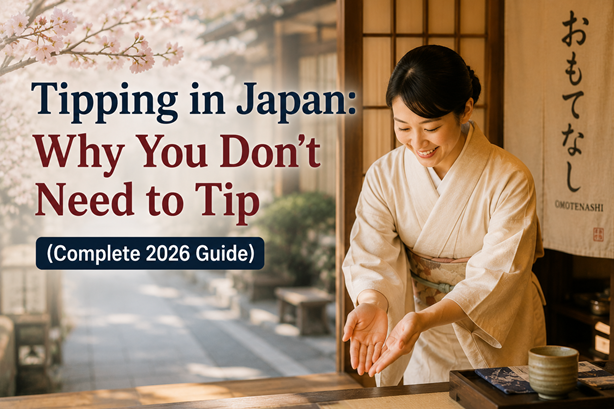
This idea is closely connected to a Japanese concept known as omotenashi.
Although often translated as “hospitality,” omotenashi means far more than simply being polite. It reflects a sincere desire to anticipate another person’s needs without expecting anything in return. The goal is not to earn a larger payment but to make the guest feel genuinely welcome.
This attitude can be found almost everywhere in Japan.
A station employee may personally walk you to the correct platform instead of simply pointing in the right direction.
A shop assistant may carefully wrap even an inexpensive purchase as though it were a gift.
A taxi driver may step out to open the door for passengers before they have time to reach the handle themselves.
None of these actions are performed because a tip might follow.
They are simply considered part of providing excellent service.
For many Japanese people, accepting extra money specifically because they did their job properly can even feel uncomfortable.
They believe they have already been paid to provide the best service possible.
🍣 Should You Tip at Restaurants in Japan?
This is probably the question travelers ask most often.
The answer is almost always no.
Whether you are eating at a tiny neighborhood ramen shop, a family-run izakaya, a conveyor belt sushi restaurant, or a Michelin-starred establishment, tipping is generally unnecessary.
After finishing your meal, simply pay the amount shown on the bill.
Nothing more is expected.
Some visitors worry that high-end restaurants might follow different rules, especially if they are accustomed to leaving twenty percent or more at home.
Fortunately, the answer remains the same.
Even at luxury restaurants where the service feels exceptionally attentive, staff members are not expecting additional money from customers.
Occasionally, you may notice a service charge already included on the bill, particularly at upscale restaurants or hotels. This charge is determined by the establishment itself and is not the same as a voluntary tip.
If a service charge appears, there is still no need to leave anything extra.
One of the reasons visitors enjoy dining in Japan is that the final price is usually straightforward. You do not have to calculate percentages, wonder how much is appropriate, or worry about offending someone by leaving too little.
The amount on the bill is simply the amount you pay.
🏨 What About Hotels and Ryokan?
Hotels follow much the same principle.
Whether someone carries your luggage, helps arrange transportation, or provides recommendations for sightseeing, tipping is generally unnecessary.
International hotel chains operating in Japan sometimes welcome guests from countries where tipping is common, but even there, staff members usually do not expect additional payment.
Traditional ryokan, however, often raise more questions.
Years ago, it was not unusual for guests to offer a small gratuity known as kokorozuke to the staff member taking care of their room. This was never a formal requirement, but rather a traditional gesture of appreciation.
Today, this custom has become much less common.
Most Japanese guests no longer offer kokorozuke, and ryokan staff certainly do not expect it from international visitors.
Instead, simply treating the staff politely, expressing your thanks, and respecting the property are considered more than enough.
In other words, you can enjoy the unique hospitality of a ryokan without worrying about preparing envelopes of cash or calculating how much to give.
🚖 Do You Tip Taxi Drivers?
The answer is once again no.
Taxi drivers in Japan are known for their professionalism. Their vehicles are remarkably clean, the doors often open automatically, and drivers usually wear uniforms and white gloves while maintaining a high standard of courtesy.
Despite this excellent service, tipping is not part of the experience.
Simply pay the fare shown on the meter.
Some travelers try to leave the small change behind, believing it will be appreciated.
Instead, many Japanese drivers will politely return the money, assuming you forgot it by accident.
This surprises many first-time visitors.
In countries where leaving the coins behind is common, the gesture feels natural.
In Japan, however, the driver is more likely to believe that you accidentally overpaid.
Returning the money is their way of providing honest service.
🧳 What About Tour Guides, Hair Salons, and Other Services?
By now, you may have noticed a pattern. Whether you are dining in a restaurant, staying in a hotel, or riding in a taxi, tipping in Japan is generally unnecessary. The same principle applies to many other services that travelers use during their visit.
If you join a guided tour operated by a Japanese company, your guide will almost certainly not expect a tip. Professional guides are paid by their employer, and providing knowledgeable, friendly service is considered part of their responsibility. At the end of the tour, a sincere “Thank you” or “Arigatou gozaimasu” is usually the most appreciated response.
There are, however, a few exceptions worth understanding. Some international tour companies that primarily serve visitors from countries where tipping is customary may mention gratuities in advance. Likewise, freelance guides who regularly work with overseas guests sometimes accept tips because their clients expect to offer them. If a tour company specifically states that tipping is welcome, you can simply follow its guidance. These situations are exceptions rather than the rule and should not be confused with traditional Japanese customs.
Hair salons follow the same philosophy. Japanese hairstylists often spend considerable time consulting with clients, carefully washing hair, and paying close attention to even the smallest details. Despite this high level of service, tipping is not expected. The price you pay already reflects the quality of the work.
Massage therapists, spa staff, delivery drivers, and countless other service professionals also do not expect gratuities. Even when someone goes out of their way to help you, offering additional cash can create confusion rather than appreciation. For many employees, company policies discourage accepting personal gifts of money, and some businesses prohibit it altogether.
Understanding this consistency makes traveling in Japan much easier. Instead of wondering whether different industries follow different tipping customs, you can simply remember one principle: unless you are specifically told otherwise, the listed price is the final price.
💴 What Happens If You Leave a Tip?
Many first-time visitors assume that even if tipping is unnecessary, leaving a little extra money cannot possibly hurt.
In Japan, the result is often quite different from what they expect.
Imagine finishing your meal, placing several extra coins on the table, and walking toward the exit. A few moments later, a staff member comes running after you with a worried expression. Rather than thanking you for your generosity, they politely hand the money back, believing you accidentally forgot it.
Stories like this are surprisingly common.
From the visitor’s perspective, leaving extra money is intended as a compliment. From the employee’s perspective, however, unexplained cash usually looks like a simple mistake. Returning it is considered part of providing honest and attentive service.
Even when staff members realize that the money was intentionally left behind, they may hesitate to accept it. Some employees worry that accepting personal tips could violate company rules, create unfair differences among coworkers, or make future interactions uncomfortable. Others simply feel that they have already fulfilled their professional responsibility and do not deserve additional payment for doing what they consider their job.
This difference in perspective illustrates one of the most fascinating cultural contrasts between Japan and countries with strong tipping traditions. In many places, a tip symbolizes satisfaction with exceptional service. In Japan, exceptional service is often viewed as the normal standard, not something reserved for customers who pay more.
😊 If You Don’t Tip, How Should You Show Appreciation?
The absence of tipping does not mean appreciation is unimportant. Quite the opposite. Japanese people value gratitude deeply, but they often express it in ways that do not involve money.
One of the simplest and most meaningful gestures is to say “Arigatou gozaimasu.” Even if your pronunciation is not perfect, most people genuinely appreciate the effort. A warm smile, eye contact, and a sincere thank-you often leave a stronger impression than cash ever could.
Showing patience and treating staff with respect are also powerful forms of appreciation. Speaking politely, waiting your turn, and following local etiquette demonstrate consideration for the people serving you. These small actions fit naturally within Japanese culture and are noticed far more than many visitors realize.
If you receive particularly memorable service, another meaningful way to express your gratitude is by leaving a positive online review. Restaurants, hotels, and local businesses value thoughtful reviews because they help future customers while recognizing the team’s hard work. Returning to the same business on a future visit is another compliment that owners and staff genuinely appreciate.
In Japan, appreciation is measured less by financial rewards and more by mutual respect. A sincere thank-you, kind words, and courteous behavior often communicate exactly what you wish to express.
🌸 What Tipping in Japan Reveals About Japanese Culture
The question of tipping in Japan is ultimately about much more than money.
It offers a glimpse into how Japanese society understands work, responsibility, and hospitality.
In countries where tipping is common, excellent service is sometimes viewed as something that deserves an additional reward. The better the service, the larger the tip. While there is nothing inherently wrong with this system, it creates a direct relationship between customer satisfaction and extra payment.
Japan developed along a different path.
Here, many people believe that providing excellent service is simply part of being a professional. A chef carefully prepares every dish because that reflects pride in their craft. A hotel employee patiently answers questions because helping guests is part of their role. A train station attendant walks a lost traveler to the correct platform because ensuring that passengers arrive safely matters more than saving a few minutes.
This way of thinking is closely connected to omotenashi, the Japanese philosophy of wholehearted hospitality. Omotenashi is not about impressing customers in the hope of receiving something in return. Instead, it is about offering genuine care without expecting a reward. The satisfaction comes from knowing that someone else’s experience has been made better.
Of course, Japan is changing like every other society. International tourism continues to grow, and some businesses that cater primarily to overseas visitors have become more familiar with tipping customs. Nevertheless, the fundamental cultural expectation remains remarkably consistent. The quality of service should never depend on the possibility of earning more money from a particular customer.
For many travelers, this realization becomes one of the most memorable lessons they take home. They discover that extraordinary hospitality can exist even in a society where tipping is almost entirely absent.
🌿 Final Thoughts
If you remember only one thing before traveling to Japan, let it be this: you do not need to tip.
Whether you are enjoying sushi at a neighborhood restaurant, checking into a luxury hotel, riding across Tokyo in a taxi, relaxing in a traditional ryokan, or shopping at a small local store, the service you receive is already given with care, professionalism, and pride. Paying the amount on the bill is enough.
More importantly, understanding why Japan does not have a tipping culture allows you to appreciate something much deeper than a simple travel tip. It reveals a society where hospitality is viewed as a responsibility rather than a transaction and where respect is expressed through sincerity instead of additional payment.
As a visitor, you do not need to calculate percentages or worry about leaving the right amount of money behind. Instead, focus on enjoying the experience, showing courtesy to the people you meet, and expressing your gratitude with a smile and a heartfelt “Arigatou gozaimasu.” Those simple gestures reflect the spirit of Japanese hospitality far more naturally than a tip ever could.
🌸 Continue Exploring Japanese Culture
If you enjoyed learning about tipping in Japan, there are many other customs that can help you travel with greater confidence while gaining a deeper understanding of Japanese culture. Continue your journey with these related guides from Real Japan Navigator.
👉How to Visit a Japanese Shrine: A Complete Etiquette Guide for First-Time Visitors (2026 Guide)
👉Why Do Japanese People Bow? Meaning, Types, and When to Do It (2026 Guide)
👉How to Call a Waiter in Japan: Why They Don’t Come Automatically (2026 Guide)
👉Umbrella Etiquette in Japan: 7 Essential Rules Every Traveler Should Know (2026 Guide)
👉The Sound of Summer in Japan: Why Cicadas Mean More Than Noise (2026 Guide)
👉Why Do Japanese People Love Fireworks So Much? (2026 Guide)