
🌏 Introduction
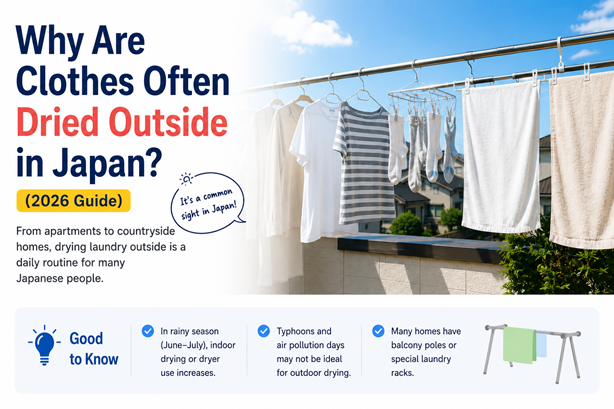
One of the small everyday habits that visitors often notice in Japan is laundry hanging outside. Walk through a residential neighborhood on a sunny day and you will likely see shirts, towels, bedsheets, and futons drying on balconies, in gardens, or on outdoor laundry racks. For many Japanese people, it is such a normal sight that they barely notice it. Yet after living overseas, I realized that this simple daily habit is not nearly as universal as I once thought.
I still remember my surprise when I first learned that in some countries, people are discouraged—or even prohibited—from hanging laundry outside. Growing up in Japan, hanging clothes on a balcony was completely normal. It was simply what everyone did. If the weather forecast predicted sunshine, it was considered a good day to do laundry. Apartment balconies were designed with clothes-drying poles. Houses often had dedicated outdoor spaces for drying clothes. Nobody questioned it.
Then I moved overseas.
One day, I learned that hanging laundry outside was uncommon in the area where I lived. In some neighborhoods, residents were even asked not to do it because it was considered unattractive or inconsistent with local housing rules. I remember thinking how strange that sounded. Until then, I had assumed that sunlight and fresh air were the natural way to dry clothes.
The more I traveled, the more I realized that laundry habits reveal surprisingly deep cultural differences. In North America, for example, dryers are everywhere. Most laundromats have rows of washing machines paired with rows of dryers. Many homes have both appliances as standard equipment. In Japan, dryers certainly exist, and their popularity has increased in recent years, but for much of modern Japanese life, outdoor drying remained the default option.
The interesting question is not whether one method is better than the other. The more fascinating question is why outdoor drying remained such an important part of everyday life in Japan.
☀️ Trusting the Power of the Sun
One reason outdoor drying became so common is simple practicality.
Japan receives plenty of sunlight throughout much of the year. For generations, people naturally used that free energy source to dry their clothes and bedding. Long before electric dryers became common household appliances, sunlight was already doing the job.
However, many Japanese people view sunlight as more than just a source of heat.
There is a widespread belief that sunshine helps clothes feel fresher and cleaner. Some people point to ultraviolet light and its natural antibacterial effects. Others simply trust the feeling that laundry dried outdoors is somehow more pleasant than laundry dried indoors.
Whether scientific or emotional, the result is the same.
Many people prefer the feeling of clothes that have spent several hours under the sun.
This preference is not necessarily unique to Japan, but it became deeply embedded in daily life here because the environment made it practical.
👕 The Meaning of “Sunshine Smell”
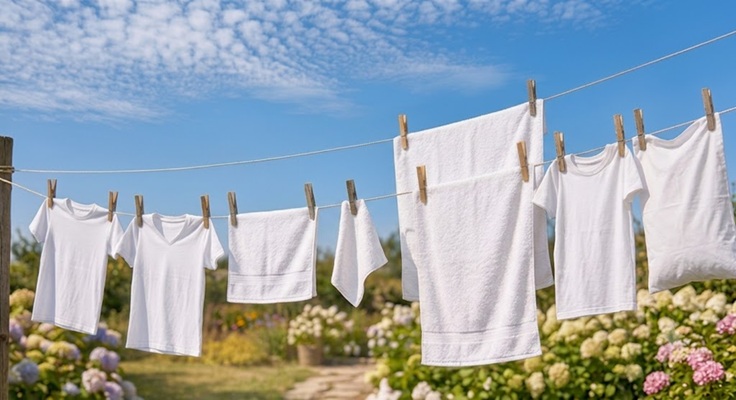
One of the most difficult things to explain to someone who did not grow up in Japan is the idea of the smell of sun-dried laundry.
Of course, sunlight itself does not have a smell.
Yet many Japanese people immediately understand what someone means when they talk about the scent of towels, sheets, or futons that have been drying outside all day.
I certainly do.
Some of my strongest childhood memories involve bringing futons back inside after they had spent hours in the sun. The moment you lay down, there was a distinctive freshness that felt comforting and familiar. Even today, that smell immediately reminds me of home.
Interestingly, researchers have suggested that what people describe as the smell of sunshine may actually come from a combination of fresh air, evaporated moisture, and chemical changes that occur while fabrics are exposed to sunlight. Regardless of the explanation, the emotional connection remains powerful.
For many people in Japan, laundry dried outside simply feels cleaner.
Not necessarily because it is objectively cleaner, but because it carries memories and associations built over decades.
🏠 Why Japanese Homes Have Balconies
Another reason outdoor drying became so common is architecture.
Many Japanese apartments and houses were designed with outdoor drying in mind.
Even relatively small apartments often include a balcony equipped with hooks or poles specifically intended for hanging laundry.
This design reflects expectation.
The assumption is that residents will occasionally dry clothes outdoors.
As a result, the entire living environment supports the habit.
In many countries, balconies are primarily recreational spaces. In Japan, they frequently serve a practical function as well.
Visitors sometimes notice clothing hanging from apartment balconies throughout residential neighborhoods. While this may seem unusual to people from dryer-dominated cultures, it is often viewed as entirely normal in Japan.
The architecture itself tells part of the story.
🌦️ Why Japanese People Check the Weather Forecast So Often
Outdoor drying also influences another everyday habit.
Many Japanese people pay close attention to weather forecasts.
Of course, everyone wants to know whether it will rain. But in Japan, laundry is often part of that calculation.
A sunny forecast means an opportunity to wash clothes, towels, sheets, or bedding.
A rainy forecast may require different plans.
This connection between weather and household routines has existed for generations.
Even today, weather reports often include information specifically useful for laundry. Some forecasts provide indicators showing whether conditions are favorable for drying clothes outdoors.
Visitors are sometimes surprised to see this level of detail.
Yet it makes perfect sense in a society where outdoor drying remains common.
🧺 Why Dryers Never Became Dominant
When discussing laundry culture in Japan, some people assume that dryers are uncommon because they are expensive.
The reality is more complicated.
Japan is a highly developed country, and modern appliances are widely available. The issue is not simply affordability.
Instead, outdoor drying remained practical enough that many households never felt a strong need to rely entirely on dryers.
For decades, the combination of balconies, seasonal sunshine, and established habits made outdoor drying a reasonable choice.
At the same time, dryers have traditionally consumed electricity, taken up space, and occasionally caused clothes to shrink or wear more quickly.
Many people therefore preferred using the sun whenever possible.
That does not mean dryers are absent from Japan.
Their popularity has increased significantly, particularly among younger families, busy professionals, and people living in regions with frequent rain or heavy snowfall.
The difference is that dryers often supplement outdoor drying rather than completely replacing it.
🌏 My Perspective After Living Overseas
Living abroad changed the way I think about laundry.
Before leaving Japan, I never considered outdoor drying to be a cultural habit. I assumed it was simply common sense.
Then I experienced countries where dryers dominated everyday life.
I saw laundromats filled with enormous dryers. I lived in places where hanging clothes outside was unusual. I met people who had never dried futons in the sun and had no idea why someone would want to.
At first, those differences surprised me.
Eventually, I came to appreciate that neither approach is inherently superior.
Dryers offer convenience. They work regardless of weather conditions. They save time. They eliminate concerns about sudden rain.
Outdoor drying offers different benefits. It uses less energy. It takes advantage of natural sunlight. Many people enjoy the feeling and scent of sun-dried fabrics.
The interesting part is not determining which method is correct.
The interesting part is understanding how different environments shaped different habits.
🌏 More Than Just Laundry
What makes this topic fascinating is that it is not really about laundry at all.
It is about the relationship between daily life and the environment.
For generations, Japanese households adapted their routines to seasonal weather. People paid attention to sunshine, rain, humidity, and changing temperatures because those factors directly affected everyday activities.
Outdoor drying became one small expression of that relationship.
Even today, despite modern technology and increasingly popular dryers, many people continue to hang clothes outside when conditions allow.
Not necessarily because they have to.
Because they want to.
Because it feels familiar.
Because it feels practical.
Because it reminds them of home.
🇯🇵 Conclusion
Why are clothes often dried outside in Japan?
The answer involves practicality, climate, architecture, habit, and memory. Generations of Japanese families relied on sunlight as a natural way to dry clothing and bedding. Homes were designed to support the practice. Weather forecasts became part of household planning. Over time, outdoor drying became woven into everyday life.
For me, the most memorable part is not the drying itself. It is the feeling that comes afterward. The scent of sun-dried towels and futons still reminds me of childhood, even after years of living overseas. That simple experience helped me realize that everyday habits often carry deeper cultural meanings than we first assume.
Outdoor drying may seem like a small detail.
But sometimes the smallest details reveal the most about how people live.
🌏 Explore More Everyday Japanese Habits
If you enjoyed learning about Japan’s outdoor laundry culture, you may also enjoy these articles exploring the everyday habits and hidden cultural logic behind daily life in Japan.
👉 Why Do Japanese People Bathe at Night Instead of the Morning? (2026 Guide)
👉 Why Do Japanese People Sleep on Trains So Easily? The Hidden Trust Behind Everyday Commuting (2026 Guide)
👉 Why Do Japanese People Express Gratitude Before Every Meal? (2026 Guide)
👉 Why Is the Summer Solstice So Quiet in Japan? (2026 Guide)
👉 Why Does Japan Change Clothes by the Calendar? Understanding a Unique Seasonal Tradition (2026 Guide)