
🌏 Introduction
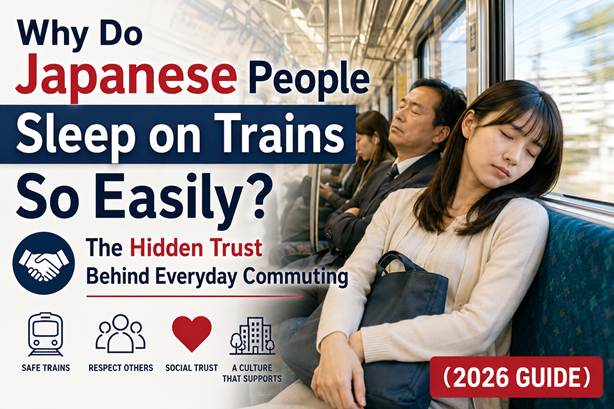
One of the first things many visitors notice when riding trains in Japan is how many people are asleep.
Not just one or two passengers. Entire rows of commuters may be sleeping. Students sleep. Office workers sleep. Elderly passengers sleep. Some people even seem capable of sleeping while standing. For many foreign visitors, the sight is both surprising and slightly amusing.
How can so many people fall asleep so easily in a public place surrounded by strangers?
As a Japanese person, I never thought much about it. Growing up in Japan, seeing people sleep on trains felt completely normal. I do it myself. If I find an empty seat after a long day, there is a good chance I will close my eyes. The gentle movement of the train can be surprisingly relaxing. For many Japanese people, sleeping on a train feels almost as natural as taking a short nap on a sofa at home.
However, I eventually learned that this behavior is not considered normal everywhere.
When I was a student living in Toronto, I once fell asleep on the subway. After a short time, the person sitting next to me woke me up. At first, I was confused. Why would someone wake me? I wasn’t making noise. I wasn’t causing trouble. Later, I mentioned the experience to one of my teachers. The teacher explained that the person had probably been worried about me. Falling asleep on public transportation could be risky, and they likely wanted to make sure I was safe.
Years later, something similar happened in Chicago. Once again, someone nearby noticed that I had fallen asleep and checked on me. Once again, I was reminded that what felt completely normal to me was not necessarily normal elsewhere.
Those experiences taught me something important. The question is not simply why Japanese people sleep on trains. The more interesting question is why so many people feel comfortable doing so.
🚆 More Than Just Being Tired
At first glance, the answer seems obvious.
Japanese people are tired.
There is certainly some truth to that. Japan is known for long commutes, busy schedules, demanding school environments, and intense work cultures. In major metropolitan areas such as Tokyo, Yokohama, Osaka, and Nagoya, commuting for an hour or more in each direction is common. Many people leave home early in the morning and return late at night.
When someone finally sits down on a train after standing all day or working for hours, falling asleep can feel almost inevitable.
But exhaustion alone does not explain the phenomenon.
People around the world get tired. Students everywhere stay up too late. Parents everywhere lose sleep. Workers everywhere feel exhausted after a long day. Yet in many countries, sleeping openly on public transportation remains relatively uncommon.
Something else is happening.
🤝 A Different Relationship With Public Space
One of the most interesting differences is how people view public space.
In some countries, public space is often treated as a place where people remain alert. Staying aware of your surroundings is considered common sense. Sleeping may make you vulnerable to theft, harassment, or simply missing your destination. Remaining awake is seen as a practical way to protect yourself.
Japan often operates differently.
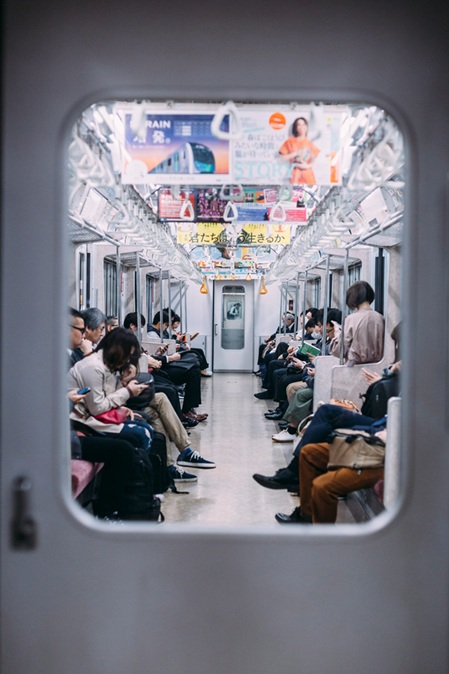
Many Japanese people view trains as an extension of daily life. Commuters ride the same routes every day. Students travel to the same schools. Office workers take the same trains year after year. Over time, trains become familiar environments rather than unpredictable spaces.
This familiarity creates a sense of comfort.
Of course, nobody believes trains are perfectly safe. Theft can happen. Accidents can happen. Common sense is still important. Yet many passengers feel that the likelihood of serious problems is low enough that closing their eyes for twenty minutes feels acceptable.
That feeling of comfort is not necessarily about safety alone. It is also about predictability.
People know what to expect.
The train will arrive on time. Passengers will generally follow social norms. Most people will quietly mind their own business.
The result is an environment that often feels surprisingly calm despite carrying millions of passengers every day.
🌏 Why Nobody Wakes Them Up
This is where things become particularly interesting.
In Toronto and Chicago, strangers woke me because they were concerned.
That concern came from kindness.
Many people outside Japan would consider checking on a sleeping stranger to be the polite thing to do.
In Japan, however, the opposite often happens.
A sleeping passenger is usually left alone.
This does not mean Japanese people are less caring. It reflects a different understanding of respect and personal boundaries.
In many situations, Japanese people believe it is polite not to interfere with others unnecessarily. If someone is quietly sleeping, they are not disturbing anyone. Waking them could be seen as interrupting their rest.
As a result, the respectful choice is often to leave them alone.
This idea appears throughout Japanese society. People tend to avoid unnecessary intrusion into the lives of strangers. They may notice what is happening around them, but they often choose not to intervene unless intervention is clearly needed.
To outsiders, this can sometimes appear distant. To many Japanese people, it feels considerate.
Neither approach is necessarily better. They simply reflect different assumptions about how strangers should interact in public.
🏙️ The Trust Hidden Beneath Everyday Life
Many articles about this topic immediately conclude that Japan is safe.
That explanation is incomplete.
I have traveled to many countries and lived overseas. I have met incredibly kind people all over the world. I have visited clean cities, safe neighborhoods, and welcoming communities outside Japan. The idea that Japan is the only safe or trustworthy society would simply be inaccurate.
What makes Japan different is not that trust exists. Trust exists everywhere.
The difference is how that trust appears in daily life.
In Japan, social trust is often built into ordinary routines. People line up without barriers. Lost items are frequently turned in. Public spaces are generally treated as shared environments that everyone should respect. Passengers are expected to keep noise levels low. Commuters usually avoid bothering those around them.
Sleeping on a train becomes possible partly because these expectations are widely understood.
Most people are following the same unwritten rules.
And when millions of people follow similar expectations, everyday life becomes more predictable.
Predictability creates comfort.
Comfort creates trust.
Trust makes sleeping on a train feel normal.
😴 The Gentle Rhythm of Japanese Trains
There is also a simpler reason.
Japanese trains can be surprisingly comfortable.
The steady rhythm, predictable movement, and relatively smooth ride create an environment that naturally encourages relaxation. Anyone who has spent time commuting in Japan knows the feeling. You sit down, the train begins moving, and within minutes your eyes start getting heavy.
I have experienced it countless times myself.
Even today, if I manage to find a seat after a long day, there is a good chance I will fall asleep before reaching my destination.
Many Japanese commuters would probably admit the same thing.
Sometimes the cultural explanations are important.
Sometimes the train is simply comfortable.
🇯🇵 Conclusion
Why do Japanese people sleep on trains so easily?
The answer is not simply because they are tired. It is not simply because Japan is safe. It is not because Japanese people are somehow different from everyone else.
The answer lies in a combination of trust, routine, predictability, long commutes, and a particular way of sharing public space.
My experiences in Toronto and Chicago taught me that different societies express care in different ways. In some places, kindness means waking a sleeping stranger. In Japan, kindness often means allowing that person to continue resting peacefully.
Neither approach is right or wrong.
They simply reflect different cultural expectations.
And perhaps that is what makes the sight of sleeping commuters so fascinating. What looks like a simple nap on a train is actually a small window into how Japanese society understands trust, personal space, and everyday life.
🔗 Curious About the Hidden Logic Behind Everyday Life in Japan?
Many things that seem ordinary in Japan—from quiet trains and punctuality to lost items being returned—are connected to deeper cultural values. Explore these articles to better understand the mindset behind daily life in Japan.
👉 Why Are Japanese Trains So Quiet? The Unspoken Rules Behind the Silence
👉 Why Are Lost Items Returned in Japan? The Culture of Honesty Explained (2026 Guide)
👉 Why Does Japan Feel So Clean? The Culture Behind Public Cleanliness (2026 Guide)
👉 Why Is Being On Time So Important in Japan? Understanding Japanese Punctuality (2026 Guide)