
🌏 Introduction
Big cities are supposed to feel overwhelming.
That is the expectation many people carry when they imagine dense urban life. Huge crowds, constant noise, rushing commuters, traffic, confusion, unpredictability, and the low-level stress that comes from always feeling slightly overloaded.
That expectation makes sense, because many major cities around the world genuinely feel that way.
Which is why Japan can feel surprising.
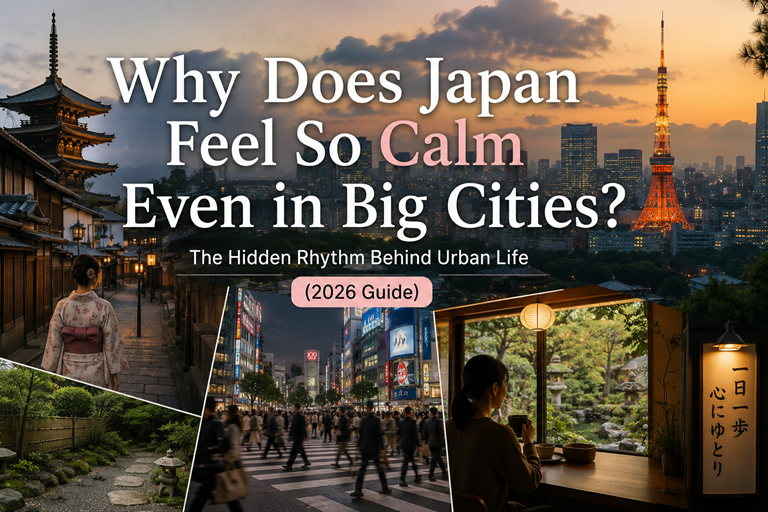
Tokyo is one of the largest urban environments on Earth. Tokyo is one of the largest urban areas in the world, with millions of people moving through its transit systems every day. Osaka is energetic, crowded, and constantly moving. Major stations handle astonishing numbers of passengers every day. On paper, these should feel like exhausting places.
And yet, many visitors describe something unexpected.
Not silence.
Not emptiness.
But calm.
That reaction is interesting because Japanese cities are not actually quiet in any simple sense. Train stations are filled with announcements. Shops play music. Crosswalks fill with moving crowds. Restaurants buzz with conversation. Daily life is active and full of movement.
So why does the emotional atmosphere often feel different?
I have spent time in large cities in different parts of the world, and what makes a city feel stressful is not always simply population. Sometimes the most exhausting cities are not the biggest ones. Sometimes smaller cities feel far more chaotic.
That suggests something important.
Perhaps calm is not the opposite of crowding.
Perhaps calm is the opposite of unpredictability.
And if that is true, then Japan becomes very interesting.
🎯 Quick Answer
Japan’s big cities often feel calmer than visitors expect not because they are quiet or uncrowded, but because shared public expectations, predictable systems, personal boundaries, and structured movement reduce the feeling of chaos. The result is an urban atmosphere that feels emotionally different from what many people associate with dense city life.
🚆 Crowds Are Not the Same as Chaos
One of the easiest assumptions to make is that more people automatically means more stress.
But anyone who has traveled enough knows that this is not always true.
A crowded place can feel manageable if movement makes sense. A less crowded place can feel exhausting if everything feels unpredictable.
That distinction helps explain Japan.
Rush hour trains in Japan are undeniably crowded. Major stations can feel astonishingly busy. Thousands of people move through the same spaces at remarkable speed.
And yet the emotional experience often feels less chaotic than visitors expect.
Why?
Because movement often has rhythm.
People tend to follow recognizable flows. Queues form naturally. Walking patterns become somewhat predictable. Train boarding follows familiar behavior. Even in density, there is often a sense that people are moving within an understood system.
That predictability reduces stress in ways people may not consciously notice.
Because chaos is mentally expensive.
Predictability is easier to process.
📱 Shared Space Comes With Shared Expectations
Another important factor may be how public space is socially understood.
In every society, public behavior follows visible and invisible expectations. Some are formal rules. Others are habits people absorb without consciously thinking about them.
Japan often feels shaped by strong shared expectations about how people should behave in common spaces.
This can be seen in small things.
People generally avoid loud phone conversations on trains. Movement in crowded spaces often follows recognizable patterns. Queuing tends to happen naturally rather than through active enforcement.
None of this means every individual behaves identically.
No society works that way.
But when broad social expectations are widely understood, the emotional atmosphere changes.
Public space feels less like competing personal behavior and more like shared navigation.
That difference matters.
🔄 Calm May Come From Predictability
One of the most interesting possibilities is that calm is not fundamentally about quietness at all.
It may be about predictability.
Human beings often tolerate complexity better than randomness.
A complicated train network can still feel manageable if it behaves consistently. A crowded intersection can still feel comfortable if movement makes intuitive sense.
But environments that feel random demand constant attention.
Where will people move?
Will someone suddenly stop?
Will the flow collapse?
Will noise escalate?
That uncertainty creates fatigue.
Japan’s cities often reduce that uncertainty.
Not perfectly.
But noticeably.
And perhaps that is one reason visitors describe calm even in places that are objectively busy.
🔊 Noise Feels Different Depending on Its Meaning
Sound matters too, but perhaps not in the way people first assume.
Japanese cities are not silent.
Anyone who has spent time in major urban areas knows this immediately.
The interesting difference may be the emotional quality of the noise.
Some urban sound feels aggressive. Honking, shouting, unpredictable confrontation, and sudden social friction create tension.
Other kinds of noise feel informational.
Train announcements may be constant, but they communicate structure. Crossing signals indicate order. Repeated station sounds create familiarity.
The sound is still present.
But emotionally, it feels different.
This may help explain why “busy” and “stressful” are not always the same thing.
🏠 Personal Boundaries in Public Life
Another subtle but important factor may be the treatment of personal boundaries.
In crowded cities, physical space is often limited.
That is true everywhere.
But emotional space can work differently.
In Japan, strangers often leave one another socially alone in public settings. Even when physical proximity is unavoidable, there is often an unspoken respect for psychological distance.
People are close, but not necessarily intrusive.
That can feel surprisingly comfortable.
Especially for visitors used to environments where crowded spaces come with more forced interaction, unpredictable confrontation, or greater social intensity.
Again, this is not universal.
But the pattern is noticeable enough that many people comment on it.
🌏 This Is Not About “Better”
This part matters.
The point is not that Japanese cities are objectively superior.
Different cities create different emotional experiences because they reflect different histories, cultures, infrastructures, and social values.
Some cities feel alive precisely because they are noisy, expressive, and socially intense. Many people love that energy.
The more interesting question is not which model is better.
It is why the emotional experience feels different.
Japan’s urban calm appears to emerge from many small interacting elements rather than one dramatic explanation.
And that complexity is what makes it interesting.
💭 Why This Helps You Understand Japan
This topic reveals something larger about modern Japan.
Calm is not created by one policy, one technology, or one cultural rule.
It emerges from repeated small behaviors, shared expectations, and systems that reduce uncertainty in daily life.
And perhaps that is true in many societies.
But in Japan, the effect often feels unusually visible.
Sometimes understanding a culture is not about dramatic traditions.
Sometimes it is about noticing why a crowded train station somehow feels emotionally easier than expected.
That kind of observation often reveals something deeper than famous tourist landmarks ever could.
🇯🇵 Conclusion
Japan’s cities are busy.
Sometimes intensely so.
But many visitors still describe them as unexpectedly calm.
That may be because calm is not the absence of movement, sound, or density.
Perhaps calm is what happens when complexity has rhythm.
When public behavior follows recognizable patterns. When systems reduce uncertainty. When shared space feels governed by mutual expectations rather than randomness.
That does not make one urban culture better than another.
But it does make Japan’s cities emotionally distinctive.
And perhaps every city has its own hidden rhythm.
Perhaps what feels calm is not silence itself, but the feeling that everyone understands the rhythm.
Have you ever visited a city that felt emotionally different from what you expected? What made it feel calm, chaotic, welcoming, or exhausting? It would be fascinating to hear.
🔗Discover the deeper side of Japan
・Why Does Silence Feel Comfortable in Japan? The Cultural Meaning Behind Quietness
・How to Use Trains in Japan: IC Cards, Shinkansen, and JR Pass Explained (2026 Guide)
・How to Use Public Toilets in Japan: What Surprises Foreigners Most (2026 Guide)