
📑 Table of Contents
- Introduction: The Little Grill That Surprises Many Foreign Residents
- 🍳 What Is a Japanese Fish Grill?
- 🌏 Japanese Fish Grills and Western Ovens: Two Different Kitchen Designs
- 🐟 How to Use a Japanese Fish Grill for the First Time
- 🔥 Single-Sided and Double-Sided Grills: What Is the Difference?
- 🍞 Beyond Fish: Unexpected Ways to Use Your Grill
- 🥐 How to Reheat Fried Foods and Other Leftovers
- 🥦 Grilling Vegetables, Small Pizzas, and Other Foods
- 🧽 Cleaning and Managing Fish Odors
- ⚠️ Important Safety Tips for Beginners
- 🏠 What This Small Appliance Reveals About Japanese Homes
- 🌱 Making the Most of Your Japanese Kitchen
- Conclusion: A Small Appliance with a Surprisingly Big Role
- 🌍 Continue Exploring the Home Series
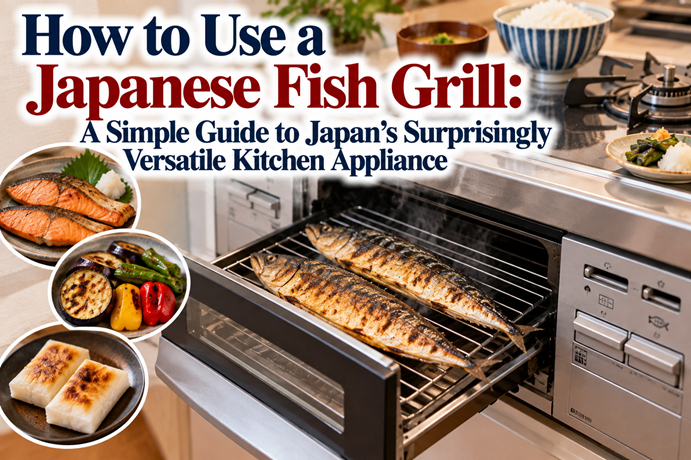
🌱 Introduction: The Little Grill That Surprises Many Foreign Residents
If you move into a Japanese apartment and look closely at the kitchen, you may discover something unexpected. Beneath the gas burners, there may be a narrow compartment that looks a little like a drawer. It has a handle, a small cooking rack inside, and a separate set of controls. If you have never lived in Japan before, you might wonder what it is for.
The answer is a Japanese fish grill, a compact appliance designed primarily for grilling fish. In Japanese, it is commonly called sakana-yaki guriru (魚焼きグリル), which literally means a grill for cooking fish. In many Japanese kitchens, it is built directly into the cooktop, allowing people to grill fish without needing a separate countertop appliance or a full-sized oven.
When I lived in the United States and Canada, I became familiar with kitchens that had large ovens beneath the stovetop. These ovens offered plenty of space for roasting meat, baking cakes, preparing casseroles, and cooking large dishes for family gatherings. I also lived in Mexico and Thailand, where kitchen equipment and everyday cooking practices were different again. A compact grill specifically designed for fish was not something I was accustomed to seeing as a standard part of the kitchen.
That contrast makes the Japanese fish grill an interesting example of how everyday appliances reflect the way people live and cook. It is not that people in other countries do not grill fish, or that Japan is the only country with compact grilling equipment. Rather, the built-in fish grill occupies a distinctive place in many Japanese home kitchens.
Its main purpose is straightforward: to cook fish quickly under intense heat. Yet the same appliance can sometimes toast bread, revive the crispness of fried foods, brown vegetables, and cook other small dishes. It is not a universal replacement for an oven, but understanding its strengths can make everyday cooking in Japan easier and more enjoyable.
This guide explains what a Japanese fish grill is, how to use it safely, how its different designs work, and how to explore its possibilities beyond fish.
🍳 What Is a Japanese Fish Grill?
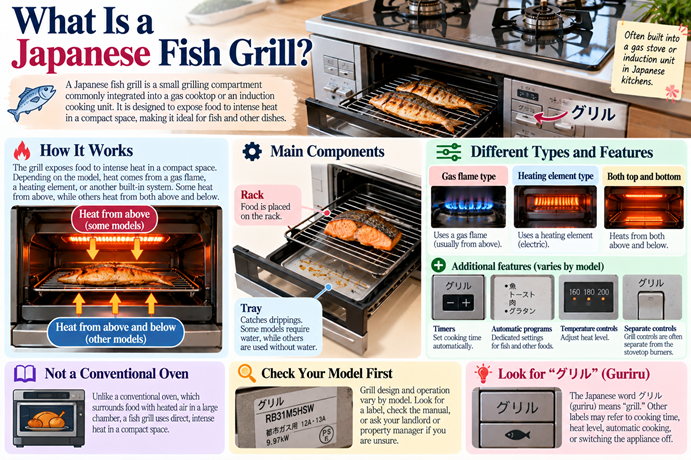
A Japanese fish grill is a small grilling compartment commonly integrated into a gas cooktop or, in some homes, an induction cooking unit. Unlike a conventional oven, which surrounds food with heated air inside a relatively large chamber, a fish grill is designed to expose food to intense heat in a compact space.
Depending on the model, the heat may come from a gas flame, a heating element, or another built-in heating system. Some grills heat food from above, while others provide heat from both above and below. The exact design affects how the food cooks and whether you need to turn it during cooking.
The compartment usually contains a rack on which food is placed and a tray underneath to catch drippings. Some models require water in the tray, while others are designed for use without water. Modern versions may have automatic cooking programs, timers, temperature controls, or dedicated settings for fish and other foods.
These differences matter. A fish grill is not one standardized appliance with a single set of operating instructions. Two kitchens that look similar from the outside may contain grills with different requirements, controls, and safety features.
If you are renting an apartment in Japan, the first step is therefore not to start cooking. It is to identify the model and understand its basic instructions. Look for a label on the appliance, check the manual if one is available, or ask the property manager or landlord for guidance if you cannot identify the controls.
You may see the Japanese word guriru (グリル), meaning “grill,” on a button or control panel. Other labels may refer to cooking time, heat level, automatic cooking, or switching the appliance off. On some models, the grill controls are separate from those for the stovetop burners.
Once you know which controls operate the grill and what preparation it requires, the appliance becomes much less mysterious.
🌏 Japanese Fish Grills and Western Ovens: Two Different Kitchen Designs
One of the most useful ways to understand a Japanese fish grill is to compare it with the large ovens found in many American and Canadian kitchens.
In the United States and Canada, a full-sized oven can be an important part of everyday cooking. Its generous interior makes it suitable for roasting a turkey, baking several trays of cookies, preparing a large casserole, or cooking food for a family gathering. It can also be used for bread, cakes, vegetables, and many other dishes.
A Japanese fish grill solves a different problem. It offers a small, dedicated space for grilling relatively small portions of food, especially fish, without requiring a separate appliance or a large amount of kitchen space.
This difference should not be exaggerated into a simple division between countries. Many homes in Western countries have broilers, outdoor grills, countertop ovens, or specialized cooking appliances. People in many parts of the world also grill whole fish over charcoal or open flames. The distinction is not that one culture knows how to grill and another does not.
Instead, the Japanese built-in fish grill represents a particular combination of cooking habits, appliance design, and available space. It places a specialized grilling function directly beside the burners used for everyday cooking.
🏡 A Different Use of Kitchen Space
Space is one practical part of the story. Japanese apartments, particularly compact urban homes, often have smaller kitchens than detached houses in North America. A full-sized oven may not be included in the kitchen, and counter space may be limited.
A built-in grill allows a household to prepare grilled fish without purchasing a separate fish roaster or allocating space to a large oven. The cooking compartment sits beneath the stovetop, making use of an area that might otherwise be occupied by another appliance.
Of course, Japanese kitchens vary considerably. Some homes have spacious kitchens and full-sized ovens, while others have only a small cooking area. The fish grill is not proof that every Japanese kitchen is tiny. It is an example of how a specialized function can be incorporated into an appliance that already occupies a central place in the kitchen.
🐟 The Role of Grilled Fish in Everyday Meals
Grilled fish is a familiar part of Japanese home cooking. A meal may include rice, miso soup, pickles, and a piece of grilled salmon or mackerel. The fish does not need to be elaborate or heavily seasoned to become the main dish.
Supermarkets commonly sell fish fillets, salted salmon, mackerel, and other products suited to quick home preparation. Depending on the store and season, you may also find dried fish or fish prepared with miso or other seasonings.
The fish grill makes this style of cooking convenient. A household can prepare a modest portion of fish without heating a large oven or using a frying pan that requires turning the fish and managing oil on the stovetop.
The result is a useful everyday appliance rather than a machine reserved for special occasions. Its value lies partly in how easily it fits into a normal meal.
🐟 How to Use a Japanese Fish Grill for the First Time
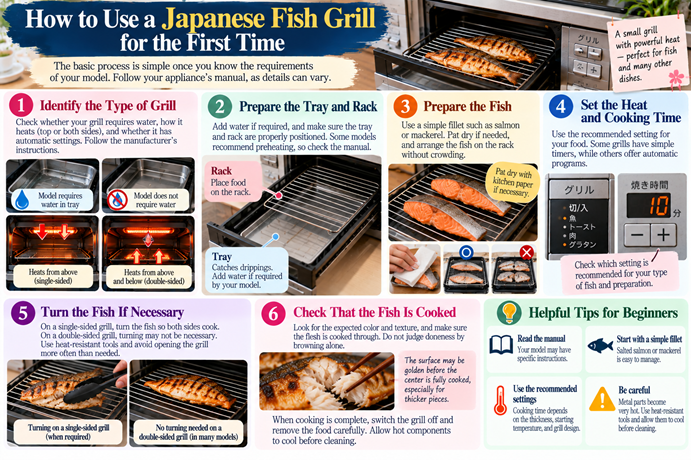
The basic process is simple once you know the requirements of your particular model. The important point is that the preparation steps can differ, especially when it comes to water, preheating, and turning the food.
Step 1: Identify the Type of Grill
Before switching it on, determine whether your grill requires water in its tray. Some older or particular models are designed for water to be added before cooking, while many newer models operate without water. Never assume that all grills work the same way.
Also check whether the grill heats from one side or both sides, and whether it has automatic cooking settings. If the manual is available, follow the manufacturer’s instructions rather than relying on a general recipe intended for a different appliance.
Step 2: Prepare the Tray and Rack
If your model requires water, add the specified amount according to the manual. Do not add water to a grill designed to operate without it unless the manufacturer explicitly instructs you to do so.
Check that the tray and rack are properly positioned. If the grill has a removable tray, make sure it is fully inserted before cooking. The tray collects drippings, and correct placement helps the appliance work as intended.
Some models recommend preheating, while others do not. Follow the instructions for your grill. If the manual specifies that the appliance should be started with the rack empty, do not put the food in until the recommended preheating stage is complete.
Step 3: Prepare the Fish
For a beginner, a simple fish fillet is often easier to manage than a whole fish. Salted salmon and mackerel are familiar examples in Japanese supermarkets, although cooking times will depend on the thickness, starting temperature, seasoning, and grill design.
If the fish is wet on the surface, gently pat it dry with kitchen paper when appropriate for the recipe. Excess surface moisture can interfere with browning. If the fish has already been salted or marinated, avoid adding extra seasoning automatically.
Arrange the fish on the rack according to the instructions for your model. Do not crowd the cooking area or allow food to touch heating elements. A grill’s small size is an advantage for quick cooking, but it also limits the amount and thickness of food it can accommodate.
Step 4: Set the Heat and Cooking Time
Choose the setting recommended for the type of food you are preparing. Some grills have a simple heat control and timer, while others provide preset programs. If the appliance has an automatic fish setting, check what type of fish and preparation it is intended for before relying on it.
There is no single cooking time that applies to every Japanese fish grill. A thin fillet can cook much faster than a thick piece of fish, and a grill that heats from both sides behaves differently from one that heats only from above.
If you are learning how your grill performs, begin with the appliance manual’s recommended settings and observe the result carefully. Once you understand how quickly your particular grill cooks, you can adjust your approach within the manufacturer’s guidelines.
Step 5: Turn the Fish If Necessary
On a single-sided grill, the food generally needs to be turned so both sides cook. Use appropriate heat-resistant tools and follow the manual’s recommended timing and procedure.
On a double-sided grill, heat reaches the food from above and below, so turning may not be necessary. This is one of the practical differences between older and newer designs.
Avoid opening the compartment more often than necessary, and take care when handling the rack or tray. Metal components can become extremely hot during cooking.
Step 6: Check That the Fish Is Cooked
Look for the expected color and texture, but do not judge doneness by browning alone. The surface may become golden before the center is fully cooked, especially when the fillet is thick.
For fish, the safest approach is to follow appropriate food-safety guidance and check that the flesh is cooked through. If you use a food thermometer, follow reliable temperature guidance for the type of fish and preparation. Do not assume that a charred surface guarantees a safe interior.
When cooking is complete, switch the grill off according to the instructions. Remove the food carefully and allow hot components to cool before cleaning them.
The first attempt may take a little experimentation, but the process becomes easier once you learn the behavior of your own appliance.
🔥 Single-Sided and Double-Sided Grills: What Is the Difference?
One reason instructions for Japanese fish grills can be confusing is that several designs are in use. The two broad types most relevant to beginners are single-sided and double-sided grills.
A single-sided grill applies its main heat from one side, often from above. The side facing the heat browns first, so the food usually needs to be turned during cooking. This is not necessarily a disadvantage; it simply means you need to pay attention to the cooking sequence.
A double-sided grill heats food from both sides. Because the lower side also receives heat, many foods can cook without being turned halfway through. This can make everyday preparation more convenient, especially when you are cooking a quick breakfast or preparing a simple dinner.
The labels “single-sided” and “double-sided” describe the direction of heating, not whether the appliance requires water. Water use is a separate design feature. A grill can be single-sided and require water, or it can have a different combination of heating and tray requirements.
💧 Water-Required and Water-Free Designs
The distinction between water-required and water-free grills is particularly important for safety and cleaning. A tray that must contain water has a specific purpose in the appliance’s design. Operating it incorrectly can affect how it functions and may create a hazard.
Water-free models are designed to operate without water in the tray. Adding water simply because you have seen someone do it with another model is not a reliable approach.
If you are staying in a furnished apartment, do not guess based on the appearance of the tray. Check the manual, look for a model number, or ask the person responsible for the property. This is one of those cases where a few minutes of checking can prevent a messy or unsafe cooking experience.
⏱️ Why the Grill Can Feel So Fast
A fish grill has a small cooking chamber and places food close to its heat source. This makes it well suited to browning and cooking relatively thin portions in a short time.
However, it is misleading to say that every fish grill reaches a particular temperature or cooks every food faster than an oven. Appliance designs differ, and actual cooking performance depends on the food, the settings, and the condition of the grill.
Think of it as a specialist for small portions and quick surface browning, not a miniature oven that can automatically replace every function of a full-sized one.
🍞 Beyond Fish: Unexpected Ways to Use Your Grill
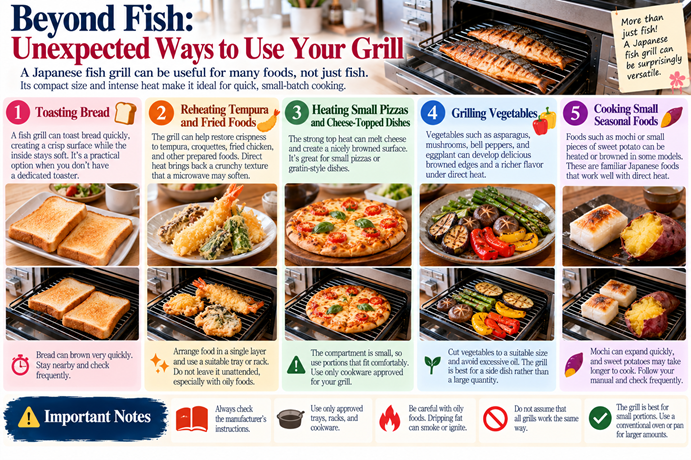
The most interesting discovery for many people is that a Japanese fish grill can sometimes be used for foods other than fish. Its compact size and intense heat make it useful for certain small cooking tasks that do not require the space of a full oven.
Before trying any alternative use, check that the manufacturer’s instructions allow it. The compartment may have a small clearance between the food and the heating elements, and some materials are unsuitable for use under direct high heat.
🍞 1. Toasting Bread
A fish grill can be useful for toasting slices of bread. Heat reaches the surface directly, so the outside can brown while the interior retains some softness. This can produce a satisfying contrast between a crisp surface and a tender middle.
The method is especially practical when the kitchen does not have a dedicated toaster. You can prepare a small breakfast without buying another appliance or using a large oven.
The main challenge is that bread can brown very quickly. A slice that looks pale at one moment may develop dark patches soon afterward, depending on its thickness and the grill’s heat. Stay beside the appliance, check the bread frequently, and never leave it unattended.
Use only a rack or accessory approved for your grill. Avoid placing bread too close to a heating element or using a material that could ignite or obstruct ventilation.
🥐 2. Reheating Tempura and Fried Foods
Japanese supermarkets often sell prepared foods such as tempura, croquettes, fried chicken, and breaded cutlets. These can be convenient, but the crisp coating may soften after the food has been packaged or refrigerated.
A microwave reheats food quickly, but it can also soften a fried coating by heating moisture inside and around it. A suitable grill may help restore some crispness by exposing the surface to direct heat.
Arrange the food in a single layer when the manual permits, and use a suitable tray or rack if required. Begin with a short heating period and inspect the food frequently. Because prepared fried foods vary in size and moisture content, there is no universal reheating time.
The grill is particularly useful for small portions. If you are reheating a large amount of food, a conventional oven may offer more space and more even control.
Take care with foods that contain oil. Dripping fat can smoke or ignite if it contacts a flame or overheated surface, so never leave the grill unattended and follow the manufacturer’s rules for cooking fatty foods.
🍕 3. Heating Small Pizzas and Cheese-Topped Dishes
Some grills can be used to heat a small pizza or brown the top of a suitable dish. The strong top heat can melt cheese and produce a browned surface without the long heating process that may be needed for a large oven.
However, the size of the compartment is a real limitation. A large pizza or a deep dish may not fit, and the top can brown before the center becomes hot. Choose small portions that fit comfortably and use cookware specifically approved for the appliance.
Do not place a glass dish, ceramic plate, or other container in the grill simply because it is described as oven-safe. A fish grill may expose cookware to direct heat and conditions that differ from those inside a conventional oven. Use only accessories and materials that the manufacturer permits.
🥦 4. Grilling Vegetables
Vegetables such as asparagus, mushrooms, bell peppers, and small pieces of eggplant may be suitable for grilling in some models. Direct heat can create browned edges and concentrate the flavor of the vegetables without requiring a large cooking space.
Cut the vegetables into pieces of a suitable size and arrange them so they do not fall through the rack. Use an approved tray or accessory if the pieces are too small for the rack itself.
Vegetables with high moisture content may soften rather than become crisp, and pieces coated with oil can drip during cooking. Avoid excessive oil and check the grill’s instructions before adding any coating or marinade.
The small cooking area makes this approach best for a side dish rather than a large tray of roasted vegetables. For larger quantities, a pan or conventional oven is usually more practical.
🍠 5. Cooking Small Seasonal Foods
Depending on the model, a grill may be useful for heating or browning foods such as mochi or small pieces of sweet potato. These foods are associated with familiar Japanese home cooking, but they behave differently under high heat.
Mochi can expand, become sticky, or brown rapidly, so it must be prepared only in a way permitted by the appliance manufacturer. Sweet potatoes may require longer, more even cooking than a small grill can provide. A large or thick potato may brown on the outside while remaining firm inside.
These examples show the potential of the appliance, but they are not universal instructions. Always consider the size, moisture, fat content, and behavior of the food before trying it.
🥐 How to Reheat Fried Foods and Other Leftovers
A useful way to think about the Japanese fish grill is as a compact appliance for reheating small foods when the goal is to restore a browned surface rather than simply make the food hot.
For example, a croquette that has lost its crisp exterior may benefit from a short period of dry heat. A slice of pizza may regain some texture around the crust. Bread may become more appealing after brief heating.
The distinction between heating and cooking is important. Reheating leftovers is not always the same as cooking raw food, and the grill’s strong surface heat may not warm a thick item evenly. If a food needs to be heated throughout, confirm that the center has reached a safe temperature.
Use a microwave, stovetop, or conventional oven when that is more appropriate for the food. The fish grill is a useful option, not a requirement for every leftover.
It is also worth remembering that the grill may retain the smell of foods cooked in it. Reheating a pastry or a piece of bread after cooking oily fish may not be ideal if the compartment has not been cleaned. If you want to use the same grill for different foods, keeping the tray and rack clean makes a noticeable difference.
🧽 Cleaning and Managing Fish Odors
Cleaning is one of the main reasons people hesitate to use a fish grill. Fish oils and food particles can collect on the rack and tray, and residue left behind may produce smoke or odors the next time the appliance is heated.
The easiest approach is to make cleaning part of the normal cooking routine. Once the grill has been switched off, allow the removable components to cool sufficiently before handling them. Follow the manual for removing the rack and tray, and clean them using the recommended method.
Some components may be dishwasher-safe, while others need to be washed by hand. Do not assume that every removable part can go into a dishwasher, and do not use abrasive cleaners on surfaces that could be damaged.
Avoid pouring water into a hot grill or handling a hot tray with bare hands. Sudden temperature changes can damage some components, and residual heat can cause burns even after the flame or heating element has been switched off.
If food has stuck to the rack, use the cleaning method recommended by the manufacturer rather than scraping aggressively. Regular cleaning is usually easier than trying to remove a thick layer of burned residue after many cooking sessions.
🌬️ Keeping Odors Under Control
Some fish naturally produce a stronger smell during cooking, particularly when the fish contains more fat or when oils and juices drip onto hot surfaces. Ventilation helps, so use the kitchen’s range hood or ventilation system when cooking.
The tray and rack should be cleaned after use as directed. Pay attention to the compartment itself as well, but do not dismantle internal components unless the manual says that they are intended to be removed by the user.
If you want to toast bread or heat pastries in the grill, clean away fish residue first. Even a small amount of old oil can affect the smell of the next food.
A fish grill is not necessarily odor-free simply because it is built into the stove. Its convenience comes from the compact cooking space, and maintaining that space is part of using the appliance well.
⚠️ Important Safety Tips for Beginners

A Japanese fish grill can be straightforward to use, but it is still a high-heat cooking appliance. The compact compartment means that food can be close to the heat source, and some ingredients can burn faster than expected.
First, read the manual for your exact model. This is especially important if you have moved into a furnished apartment and do not know whether the appliance requires water, how to set the heat, or which accessories are permitted.
Second, never leave the grill unattended while it is operating. Bread, oily foods, and sugary marinades can brown or burn quickly. If you need to leave the kitchen, switch the appliance off rather than leaving it running.
Third, avoid cooking food that is too large for the compartment or that touches the heating elements. Do not block vents or place combustible materials near the grill. Keep towels, paper packaging, and other flammable objects away from the hot appliance.
Fourth, use only approved cookware and accessories. Ordinary baking paper, plastic containers, and dishes that are unsuitable for direct high heat can be dangerous. Aluminum foil and cooking sheets should not be used unless the manufacturer’s instructions explicitly permit them for the specific model and cooking task.
Fifth, be careful when opening the compartment and removing food. Hot air and steam may escape, while the rack and tray can remain hot after cooking. Use suitable heat-resistant tools or oven mitts as directed, and place hot components on a heat-resistant surface.
Finally, clean the grill regularly and make sure that removable components are correctly reinstalled. If you smell gas, notice unusual appliance behavior, or suspect a malfunction, stop using the appliance and seek appropriate assistance rather than attempting an improvised repair.
For general information about using a Japanese stove, Kagawa University provides an English-language guide to stove controls and the grill compartment. Japan’s Ministry of Economy, Trade and Industry also publishes information on product safety and gas appliances.
🏠 What This Small Appliance Reveals About Japanese Homes
The fish grill is more than a convenient place to cook salmon. It offers a small glimpse into how Japanese homes combine everyday habits with practical design.
A kitchen appliance does not need to be large or multifunctional to be useful. Sometimes, a specialized compartment that performs one task well can be more convenient than a large appliance that does many things but requires more space, energy, or preparation.
The fish grill also fits naturally into the rhythm of a Japanese home meal. A piece of fish can be grilled while rice cooks in a rice cooker and soup warms on the stovetop. The cooking tasks happen in parallel, and each appliance has a clear role.
This does not mean that all Japanese households cook in the same way. Some people rarely prepare fish at home, while others cook it regularly. Some households use microwave ovens, countertop ovens, electric grills, or other equipment instead. The fish grill is one part of a varied domestic landscape.
Still, it is a useful reminder that familiar household objects can reveal cultural patterns. The way a kitchen is arranged reflects the kinds of meals that are convenient to prepare, the space available, and the small routines that make everyday life work.
For someone who has lived in a country where a large oven is a central kitchen feature, a Japanese fish grill may initially look like a curious extra. After learning how it works, however, it becomes easier to see why a household might appreciate a compact appliance that grills fish quickly and handles a few other small tasks.
🌱 Making the Most of Your Japanese Kitchen
If you are new to Japan, you do not need to master every appliance immediately. Start with the tools you understand, then learn about unfamiliar equipment one piece at a time.
With a fish grill, the best starting point is a simple recipe and a clear understanding of the model. Learn whether it needs water, whether it heats from one side or both, and which settings are suitable for your food. Once you are comfortable with the basics, you can consider whether the appliance is suitable for toast, reheating fried foods, or grilling vegetables.
It is also worth observing how Japanese supermarkets prepare ingredients for home cooking. Salted fish, small fillets, and ready-to-cook portions can make the grill easier to use, especially when you are cooking for one or two people. You do not need to prepare a complicated meal to make good use of it.
At the same time, recognize the limits of the appliance. A fish grill is not a substitute for every oven function, and its small size means that it works best with modest portions. For cakes, large roasts, deep casseroles, and dishes that require stable temperatures over a long period, a suitable oven or another cooking method is usually more appropriate.
The aim is not to use the grill for everything. It is to understand what it does well and let it make the right kinds of cooking a little easier.
🎯 Conclusion: A Small Appliance with a Surprisingly Big Role
A Japanese fish grill may seem unusual if you are accustomed to a kitchen with a large oven. Its compact design and dedicated purpose make it different from the equipment many people know from other countries, but that difference is part of what makes it interesting.
The grill is designed primarily for cooking fish, a familiar component of many Japanese home meals. Depending on the model, it can also be useful for toasting bread, reheating certain fried foods, browning small dishes, and grilling vegetables. These extra uses can be convenient, provided that the appliance instructions allow them and you pay attention to heat, cleaning, and safety.
Most importantly, learning to use a fish grill is a small step toward understanding everyday life in Japan. The country’s homes are full of practical details that can be easy to overlook until you try to live with them. A compact cooking compartment can tell you something about kitchen design, food preparation, and the value of making limited space work efficiently.
You may not need a fish grill in every kitchen, and you certainly do not need to turn it into an all-purpose oven. But once you understand how it works, you may find that this small Japanese appliance is much more useful than it first appears.
🌍 Continue Exploring the Home Series
Japanese homes become easier to understand when you look beyond their layout and furniture to the everyday habits, practical choices, and small details that shape domestic life. Explore more articles in the Home Series to discover how people live, cook, organize their spaces, and experience daily life in Japan.
👉 What’s Inside a Japanese Refrigerator? What Everyday Food Reveals About Life in Japan
👉 What Is a Kamidana? Understanding the Shinto Altar in Japanese Homes
👉 Japanese Kitchens vs. American Kitchens: Space, Storage, Appliances, and Daily Life
👉 Opening Windows in Japan: Fresh Air, Seasonal Breezes, and Everyday Home Life