
🌏 Introduction
Many visitors expect Japan to be hot in summer.
That part is true.
But what often surprises people is that the real challenge is not simply the temperature.
It is the humidity.
I have experienced summer in different countries, including places where the actual air temperature was even higher than Japan. Some countries regularly climb above 100°F (38°C). On paper, that sounds hotter than Japan.
And yet, Japan can feel harder.
Why?
Because summer in Japan is often a combination of heat and extremely high humidity. Even on days without rain, humidity can climb to uncomfortable levels, making the air feel heavy, sticky, and exhausting in a way many visitors underestimate.
I once saw an interview with visitors from countries near the equator saying, “Japan is hot.” That made me laugh a little—not because they were wrong, but because it perfectly captured how surprising Japanese summer can be. When people from naturally hot climates say Japan feels intense, you know humidity is doing something powerful.
This is not simply about discomfort.
Summer in Japan can be physically dangerous if underestimated.
Every year, adults and children alike are warned about heat exhaustion and heatstroke. Local news covers it constantly. Schools, sports clubs, workplaces, and families all take it seriously.
That may sound dramatic, but it is practical reality.
The good news is that once you understand how Japanese summer works, it becomes much easier to manage.
🎯 Quick Answer
Surviving summer in Japan is less about preparing for extreme temperatures alone and more about managing the combination of heat and humidity. Staying hydrated, avoiding prolonged midday exposure, wearing breathable clothing, using cooling tools, and planning your daily rhythm carefully can make an enormous difference.
Japan in summer can still be enjoyable—but preparation matters.
☀️ Why Japan Feels Hotter Than You Expect
Temperature tells only part of the story.
Many travelers check the forecast, see a number they think they can handle, and assume everything will be fine.
Then they step outside.
The shock comes quickly.
Humidity changes how heat feels.
When the air is already full of moisture, sweat does not evaporate as efficiently, which makes it harder for the body to cool itself naturally. That is one reason why even temperatures that may not seem extreme on paper can feel overwhelming in real life.
Instead of simply “hot,” the air can feel thick.
Walking for even short periods can leave you sweaty and drained. Clothes may feel damp quickly. Moving between air-conditioned indoor spaces and heavy outdoor humidity can become physically tiring in its own way.
This is often what surprises visitors most.
It is not the number on the weather app.
It is the experience.
💧 Hydration Is Not Optional
One of the most important things to understand about Japanese summer is that hydration is not something to think about only when you feel thirsty.
By the time you feel obviously dehydrated, you may already be behind.
Carrying water becomes a simple but powerful habit.
A small reusable bottle can make daily life much easier, especially because Japan offers many opportunities to refill it. One particularly useful tool is the mymizu app, which helps users find water refill points across Japan. For travelers trying to reduce plastic waste while staying hydrated, it can be surprisingly practical.
Even without that app, vending machines and convenience stores are everywhere, making drinks easy to find.
Still, easy access does not replace habit.
People often get busy sightseeing, shopping, or walking between destinations and forget how much fluid they are losing.
Japanese summer does not reward that mistake.
🥵 Heatstroke Is a Real Concern
This is not just about feeling uncomfortable.
Heatstroke is taken seriously in Japan for good reason.
Every summer, health warnings appear repeatedly. Schools adjust activities. Sporting events change schedules. Parents watch children carefully. Elderly people are especially vulnerable, but healthy adults can absolutely be affected too.
Visitors sometimes assume heat-related illness happens only to people doing intense exercise.
That is not true.
Walking through a city for hours, standing in direct sun, waiting outdoors, or simply underestimating humidity can be enough.
That is why pacing matters.
Japan is full of places worth exploring, but summer is not always the season for trying to do everything at maximum intensity.
👕 Dress for Humidity, Not Just Style
This may sound obvious, but many visitors still underestimate how much clothing choices matter.
Japanese summer often punishes heavy fabrics.
Breathable clothing makes a noticeable difference. Lightweight fabrics, comfortable shoes, and clothing that dries quickly can make daily movement far easier.
This becomes especially important because even short outdoor walks can quickly become sweaty.
Fashion matters less when you feel overheated and exhausted.
Comfort becomes practical survival.
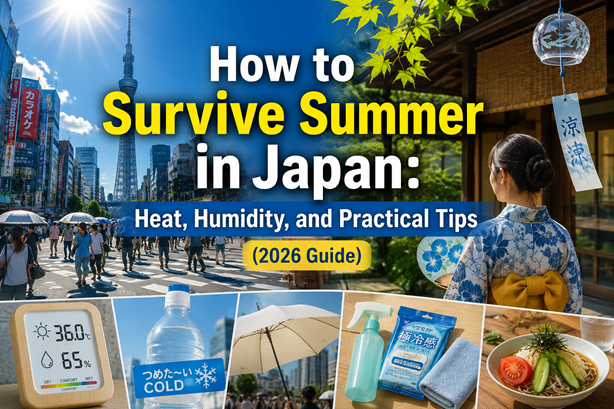
You will also quickly notice how many people in Japan use small cooling tools in summer. Portable fans, cooling towels, UV umbrellas, cooling sprays, and other practical products become part of everyday life.
That alone tells you something.
When locals actively adapt, visitors probably should too.
🕒 Timing Changes Everything
One of the easiest mistakes visitors make is planning summer days as if weather conditions remain equally manageable from morning to evening.
They do not.
Midday can be brutal.
The difference between walking at 11:30 AM and walking at 7:30 PM can feel dramatic.
That means timing matters.
Early mornings often feel far more comfortable for walking, sightseeing, or outdoor exploration. Evenings can also be easier, though humidity sometimes remains stubbornly high.
Planning indoor activities during peak afternoon heat can make an enormous difference.
Japan’s summer becomes much easier when you stop fighting the climate and start adjusting your rhythm to it.
🚉 Air Conditioning Is Both a Blessing and a Shock
One funny part of Japanese summer is the constant contrast between outdoor heat and indoor cooling.
Step outside and you may immediately feel sticky and drained.
Step inside a train, department store, or café, and suddenly the temperature may drop dramatically.
This is helpful, of course.
But repeated transitions can also be tiring.
Some people even find themselves carrying light layers simply because indoor spaces can feel much cooler than expected.
It is one of those small practical realities that visitors often discover quickly.
🏪 Convenience Stores Become Survival Tools
Japanese convenience stores are useful year-round, but in summer they become something close to emergency support systems.
Cold drinks, electrolyte beverages, ice cream, cooling products, quick food, and temporary relief from the heat all become immediately valuable.
This is one reason convenience stores feel so integrated into daily life.
In summer especially, they are not just convenient.
They are practical survival infrastructure.
🌏 Summer in Japan Can Still Be Wonderful
All of this may sound intimidating.
And honestly, summer in Japan can be challenging.
But that does not mean it is miserable.
Summer also brings festivals, fireworks, long daylight hours, seasonal foods, and a very distinct energy that many people genuinely love.
The key difference is preparation.
Visitors who underestimate Japanese summer often struggle.
Visitors who adapt usually enjoy it much more.
The climate does not need to ruin the experience.
But it does deserve respect.
🇯🇵 Conclusion
Japanese summer is not simply hot.
It is the combination of heat, humidity, and physical exhaustion that catches many people off guard.
That is why surviving summer here is less about toughness and more about smart habits—hydrating early, pacing yourself, dressing appropriately, using practical tools, and adjusting your daily rhythm.
Even people from hot climates can be surprised.
Because sometimes humidity changes everything.
And once you understand that, Japan’s summer becomes much easier to navigate.
What is summer like where you live? Dry heat, tropical humidity, or something completely different? It would be fascinating to hear how people experience summer around the world.
🔗Link to ”water refill app” : mymizu
🔗Explore more of Japan
・How to Survive Japan’s Rainy Season: Practical Tips for Everyday Life
・Why Is Japanese Convenience Store Food So Good? More Than Just Quick Snacks (2026 Guide)
・Essential Travel Tools for Japan: Everything You Need for a Smooth Trip (2026 Guide)