
🌏 Introduction
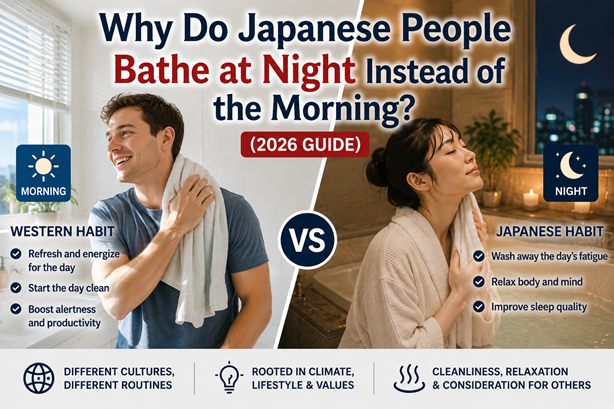
One thing I have noticed while living overseas and traveling through different countries is that people approach bathing very differently. In some places, taking a shower in the morning is considered completely normal. People wake up, take a quick shower, get dressed, and start their day. The purpose is often simple: to feel refreshed, wake up properly, and prepare for work or school. When I first lived abroad, I met many people who followed this routine, and honestly, it made perfect sense to me.
Yet despite living in different countries and spending years traveling, I have never really changed my own habit. I almost always take a bath or shower at night. During summer, I sometimes shower in the morning as well because Japan can be hot and humid, but even then I still want to wash before going to bed. If I skip my evening shower, something feels unfinished. It feels as if the day has not properly ended.
For a long time, I assumed this was simply a personal preference. The older I get, however, the more I realize that many Japanese people seem to feel the same way. It is common to hear people say that they want to wash away the day’s sweat before bed. Others say they cannot relax unless they have taken a bath. Some feel uncomfortable getting into clean sheets without first cleaning themselves. None of these explanations sound particularly unusual in Japan. In fact, they sound completely ordinary.
The interesting question is why.
Why do so many Japanese people prefer bathing at night instead of in the morning?
The answer is not that one approach is better than the other. Morning showers make sense. Evening baths make sense. Different countries developed different habits for different reasons. What is interesting is how these habits become so deeply embedded in daily life that people rarely stop to think about them.
🌙 Bathing Is About Ending the Day, Not Starting It
One of the biggest differences I noticed while living abroad was that many people seemed to view bathing as preparation for the day ahead. The shower was part of the morning routine. It helped people wake up, feel energized, and get ready to leave the house.
For many Japanese people, bathing often serves a different purpose. It is less about preparing for the outside world and more about leaving the outside world behind.
When the day begins, most people are thinking about what they need to do. They go to work, attend classes, commute on trains, meet clients, study, exercise, shop, or spend time with friends. Throughout the day, they move between different places and interact with different people. By the time they return home, many people feel mentally and physically tired.
Bathing often becomes a transition point.
Before the bath, the day is still continuing. Emails may still need replies. Homework may still need attention. Household chores may still be waiting. After the bath, however, something changes. The day begins to slow down. The mind relaxes. The evening feels different.
When I think about my own routine, this is probably one of the biggest reasons I continue bathing at night. It is not simply about being clean. It is about creating a clear boundary between the active part of the day and the restful part of the day.
Without realizing it, many Japanese people seem to use bathing as a daily reset button.
👦 The Habit Often Begins in Childhood
Whenever I think about why I prefer bathing at night, my thoughts eventually return to childhood.
Like many Japanese children, I spent a lot of time outside. I played sports. I ran around parks. I rode my bicycle. During summer, I would come home sweaty and exhausted. Sometimes my clothes were dirty. Sometimes my knees were covered in mud. None of this was unusual.
What happened next was also completely normal.
I came home and took a bath.
Nobody explained the cultural meaning behind it. Nobody gave a lecture about hygiene or social values. It was simply part of daily life.
Looking back, I think this is true for many Japanese people. Bathing at night is not usually something they consciously choose as adults. It is something they have been doing since childhood.
This matters because habits learned early in life tend to stay with us. Even after moving to another country, changing jobs, or starting a family, some routines remain surprisingly stable.
I often notice this when talking with Japanese friends who have lived abroad. Many of them continue taking evening baths or showers even after spending years in countries where morning showers are more common. The habit feels natural because it was learned so early.
When people say that Japanese culture values bathing, they often focus on hot springs or traditional baths. Those things are certainly important, but I sometimes think the deeper story begins much earlier. It begins with ordinary children returning home after an ordinary day and doing what they have always done.
🛏️ Clean Body, Clean Bed
Another idea that frequently appears in Japan is the relationship between bathing and sleep.
Many people do not necessarily think about this in a philosophical way. It is simply a feeling.
The bed is clean.
Therefore, the body should be clean too.
When I explain this to friends from other countries, some immediately understand it and some find it slightly unusual. Neither reaction is surprising.
Different societies develop different ideas about what feels comfortable.
For many Japanese people, there is something satisfying about getting into bed after washing away the sweat and dust of the day. It creates a sense of closure. The day is finished. The body is clean. The mind can relax.
This does not mean Japanese people are obsessed with cleanliness. Nor does it mean people in other countries are less clean. The difference is more subtle than that.
It is about timing.
In some places, cleanliness is strongly associated with the start of the day. In Japan, cleanliness is often associated with the end of the day.
That difference changes when people choose to bathe.
🌏 What Living Abroad Taught Me
Living overseas helped me notice many things about Japan that I had previously taken for granted. Bathing was one of them.
In Toronto, I met people who showered every morning. In the United States, I met many people who did the same. Nobody thought it was unusual. In fact, many people seemed surprised that I preferred showering at night.
The more I talked with people, the more I realized that neither approach was strange.
Each one reflected a different way of organizing daily life.
For some people, the shower helped them wake up and prepare for the challenges ahead.
For me, and for many Japanese people, the bath helped bring the day to a close.
What struck me most was that these habits often felt emotional rather than logical. People defended their routines not because they had scientifically analyzed them but because those routines simply felt right.
I was no different.
Even after years abroad, I continued taking evening showers. I liked feeling clean before bed. I liked washing away the day’s sweat. I liked the sense of relaxation that followed.
Most importantly, I slept better.
Whether that effect was physical, psychological, or simply the result of habit hardly mattered. The routine worked for me.
🇯🇵 More Than Cleaning
Perhaps the most interesting thing about bathing at night is that it often serves purposes beyond hygiene.
It marks the transition from public life to private life.
It separates work from rest.
It creates a predictable rhythm within the day.
In a world that often feels busy and chaotic, small rituals can become surprisingly important.
Some people read before bed. Some drink tea. Some take a walk.
Many Japanese people take a bath.
That habit may not seem particularly meaningful at first glance. Yet when millions of people repeat the same ritual every evening for years, it becomes part of the culture itself.
Not because anyone forces them to do it.
Not because it is uniquely Japanese.
But because it fits naturally into the way many people experience daily life.
🎯 Conclusion
Why do Japanese people bathe at night instead of in the morning?
The answer is not simply cleanliness. It is not simply tradition either. For many people, bathing at night represents a natural transition between the outside world and the comfort of home. It is a habit learned in childhood, reinforced through daily life, and carried into adulthood without much conscious thought.
My own experience has taught me that different countries develop different routines. Morning showers and evening baths both make sense depending on the culture, climate, and lifestyle. What interests me most is not which approach is better but how deeply these habits become part of who we are.
Even after living overseas and traveling extensively, I still find myself taking a bath or shower at night. Perhaps it is because I want to wash away the day’s sweat. Perhaps it is because I sleep better afterward. Or perhaps it is simply because, after all these years, my mind still associates a warm bath with the feeling that the day is finally complete.
🌏 Explore More Everyday Habits That Reveal the Real Japan
Many ordinary Japanese routines have deeper stories behind them. If you enjoyed this article, explore these guides to better understand the habits, values, and everyday experiences that shape life in Japan.
👉 Why Do Japanese People Love Bathing So Much? The Culture Behind Ofuro and Relaxation
👉 Why Do Japanese People Sleep on Trains So Easily? The Hidden Trust Behind Everyday Commuting
👉 Why Does Silence Feel Comfortable in Japan? The Cultural Meaning Behind Quietness
👉 Why Does Japan Feel So Calm Even in Big Cities? The Hidden Rhythm Behind Urban Life